Home » CBSE Syllabus of Class 12th MATH 2022-2023:
In the 12th science curriculum, mathematics is divided into two main categories – Pure Mathematics and Applied Mathematics. Pure Mathematics covers topics such as calculus, algebra, and geometry, while Applied Mathematics includes topics such as statistics, probability, and numerical analysis. Students in the 12th science curriculum are exposed to a wide range of mathematical concepts and principles, including functions, limits, differentiation, integration, trigonometry, matrices, determinants, vectors, and probability.
No.
Units
No. of Periods
Marks
I.
Relations and Functions
30
08
II.
Algebra
50
10
III.
Calculus
80
35
IV.
Vectors and Three – Dimensional Geometry
30
14
V.
Linear Programming
20
05
VI.
Probability
30
08
Total
240
80
Internal Assessment
20
Unit-I: Relations and Functions
Unit-I: Relations and Functions
1. Relations and Functions 15 Periods Types of relations: reflexive, symmetric, transitive and equivalence relations. One to one and onto functions.
2. Inverse Trigonometric
Definition, range, domain, principal value branch. Graphs of inverse trigonometric functions.
Unit-II: Algebra
1. Matrices
Concept, notation, order, equality, types of matrices, zero and identity matrix, transpose of a matrix, symmetric and skew symmetric matrices. Operation on matrices: Addition and multiplication and multiplication with a scalar. Simple properties of addition, multiplication and scalar multiplication. On- commutativity of multiplication of matrices and existence of non-zero matrices whose product is the zero matrix (restrict to square matrices of order 2). Invertible matrices and proof of the uniqueness of inverse, if it exists; (Here all matrices will have real entries).
2. Determinants
Determinant of a square matrix (up to 3 x 3 matrices), minors, co-factors and applications of determinants in finding the area of a triangle. Adjoint and inverse of a square matrix. Consistency, inconsistency and number of solutions of system of linear equations by examples, solving system of linear equations in two or three variables (having unique solution) using inverse of a matrix.
Unit-III: Calculus
1. Continuity and Differentiability
Continuity and differentiability, chain rule, derivative of inverse trigonometric functions, 𝑙𝑖𝑘𝑒 sin−1 , cos−1 𝑥 and tan−1 𝑥, derivative of implicit functions. Concept of exponential and logarithmic functions. Derivatives of logarithmic and exponential functions. Logarithmic differentiation, derivative of functions expressed in parametric forms. Second order derivatives.
2. Applications of derivatives
Applications of derivatives: rate of change of bodies, increasing/decreasing functions, maxima and minima (first derivative test motivated geometrically and second derivative test given as a provable tool). Simple problems (that illustrate basic principles and understanding of the subject as well as real- life situations).
3. Integrals
Integration as inverse process of differentiation. Integration of a variety of functions by substitution, by partial fractions and by parts, Evaluation of simple integrals of the following types and problems based on them. dx dx dx dx dx ax ∫ x2 ± a2, ∫ √x2 ± a2 , ∫ √a2 − x2 , ∫ ax2 + bx + c , ∫ √ 2+bx+c px + q ∫ ax2 + bx + c px + q dx, ∫ dx, ∫ √a2 ± x2 dx, ∫ √x2 − a2 dx √ax2+bx + c ∫ √𝑎𝑥2 + 𝑏𝑥 + 𝑐 𝑑𝑥, Fundamental Theorem of Calculus (without proof). Basic properties of definite integrals and evaluation of definite integrals.
4. Applications of the Integrals
Applications in finding the area under simple curves, especially lines, circles/ parabolas/ellipses (in standard form only)
5. Differential Equations
Definition, order and degree, general and particular solutions of a differential equation. Solution of differential equations by method of separation of variables, solutions of homogeneous differential equations of first order and first degree. Solutions of linear differential equation of the type.
Unit-IV: Vectors and Three-Dimensional Geometry
1. Vectors
Vectors and scalars, magnitude and direction of a vector. Direction cosines and direction ratios of a vector. Types of vectors (equal, unit, zero, parallel and collinear vectors), position vector of a point, negative of a vector, components of a vector, addition of vectors, multiplication of a vector by a scalar, position vector of a point dividing a line segment in a given ratio. Definition, Geometrical Interpretation, properties and application of scalar (dot) product of vectors, vector (cross) product of vectors.
2.Three – dimensional Geometry
Direction cosines and direction ratios of a line joining two points. Cartesian equation and vector equation of a line, skew lines, shortest distance between two lines. Angle between two lines.
Unit-V: Linear Programming
1. Linear Programming
Introduction, related terminology such as constraints, objective function, optimization, graphical method of solution for problems in two variables, feasible and infeasible regions (bounded or unbounded), feasible and infeasible solutions, optimal feasible solutions (up to three non-trivial constraints).
Unit-VI: Probability
1. Probability
Conditional probability, multiplication theorem on probability, independent events, total probability, Bayes’ theorem, Random variable and its probability distribution, mean of random variable.
Conclusion
In conclusion, mathematics is an essential subject in the 12th-grade science curriculum. It provides students with a strong foundation in mathematical concepts, principles, and techniques, which are essential for pursuing careers in science, technology, engineering, and mathematics (STEM) fields. The study of mathematics in the 12th-grade curriculum enables students to develop critical thinking skills, problem-solving skills, and analytical skills.
FAQS
1.What is the difficulty level of 12th-grade mathematics?
The difficulty level of 12th-grade mathematics can vary depending on the student’s aptitude and understanding of the subject. However, in general, it is considered to be more challenging than the mathematics studied in the earlier grades.
2.What are the topics covered in 12th-grade mathematics?
The topics covered in 12th-grade mathematics include calculus, algebra, geometry, trigonometry, matrices, determinants, and vectors, among others.
3.What are the career options available for students who study 12th-grade mathematics?
Students who study 12th-grade mathematics have a wide range of career options available to them, including engineering, data analysis, finance, statistics, actuarial science, and many others.
4.How can students prepare for 12th-grade mathematics exams?
To prepare for 12th-grade mathematics exams, students can practice regularly, solve previous years’ question papers, attend coaching classes, and seek help from their teachers or peers whenever needed.
5.Is it essential to study mathematics in 12th-grade science?
Yes, it is essential to study mathematics in 12th-grade science as it provides a strong foundation for pursuing further studies in science, technology, engineering, and mathematics (STEM) fields. Mathematics is also a mandatory subject for many competitive exams, including engineering and medical entrance exams.
MGGS 2026 Admission Process: Your Guide to Applying for Rajasthan’s English Medium Schools The Mahatma Gandhi Government Schools (MGGS) admission process for the 2026 academic year is fast approaching in Rajasthan. This initiative by the [...]
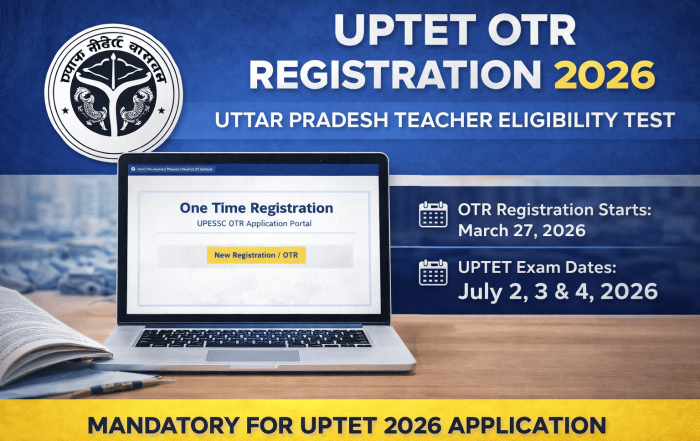
Introduction The UPTET OTR Registration 2026 has officially started for all candidates planning to appear in the Uttar Pradesh Teacher Eligibility Test (UPTET) 2026. This year, the Uttar Pradesh Education Service Selection Commission (UPESSC) has [...]
Introduction The Punjab Police Constable Recruitment 2026 is officially underway, offering a total of 3,298 vacancies in both the District Police Cadre and Armed Police Cadre. This recruitment drive provides a great opportunity for individuals [...]
Rajasthan LDC Recruitment 2026: Apply for 10,644 Vacancies The Rajasthan Staff Selection Board (RSSB) has announced 10,644 vacancies for Clerk Grade-II (LDC) and Junior Assistant posts across various departments in Rajasthan. The tentative exam date [...]
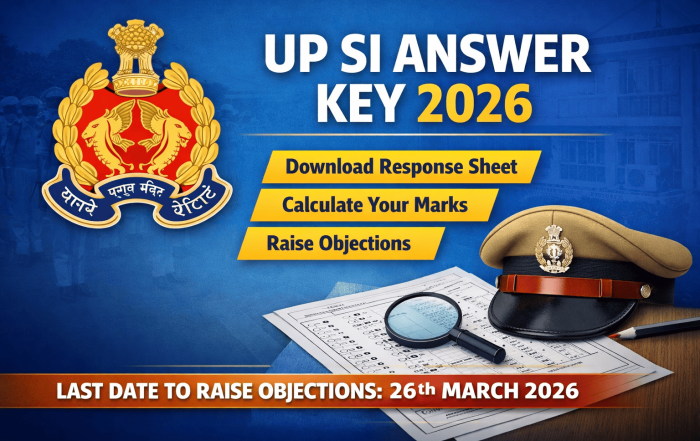
UP SI Answer Key 2026 Released: Download Response Sheets & Calculate Marks The Uttar Pradesh Police Recruitment & Promotion Board (UPPBPB) has officially released the UP SI Answer Key 2026 on 23rd March 2026. If [...]
NCERT Admit Card 2026 Out: Download Now The NCERT Admit Card 2026 📢 is now available for Group A, B, and C non-teaching posts. Candidates who completed the application process can now download their hall [...]
ICSI Recruitment 2026 – Quick Highlights Particulars Details Organization Institute of Company Secretaries of India (ICSI) Job Type Government / Statutory Body Jobs Posts Driver, Executive, Technical & Administrative Salary ₹19,900 to ₹63,200+ Application Mode [...]
GATE Result 2026 Released: Check Your Scorecard & Rank at gate2026.iitg.ac.in The Graduate Aptitude Test in Engineering (GATE) 2026 results are officially out! If you appeared for the GATE 2026 exam, it's time to check [...]
DRDO CEPTAM 11 Admit Card 2026: How to Download Your Hall Ticket The highly anticipated DRDO CEPTAM 11 Admit Card 2026 is officially available today! If you’re gearing up for the CBT exam scheduled on [...]
KVS NVS Tier 2 Admit Card 2026 – Download & Exam Details Are you ready for the KVS NVS Tier 2 Examination 2026? If you’ve successfully cleared the Tier 1 exam, the next step is [...]



 ax ∫ x2 ± a2, ∫ √x2 ± a2 , ∫ √a2 − x2 , ∫ ax2 + bx + c , ∫ √ 2+bx+c px + q

 dx, ∫ dx, ∫ √a2 ± x2 dx, ∫ √x2 − a2 dx √ax2+bx + c ∫ √𝑎𝑥2 + 𝑏𝑥 + 𝑐 𝑑𝑥,
  Fundamental Theorem of Calculus (without proof). Basic properties of definite integrals and evaluation of definite integrals.