Home » Class 6 History Chapter 4: Timeline & Sources Explained

Social Science – History

Exploring Society: India and Beyond

Class 6 History Chapter 4: Timeline and Sources of History

Understanding history becomes easier when students connect lessons with real-life examples. Class 6 History Chapter 4: Timeline and Sources of History focuses on timelines, historical sources, and practical activities that help learners think like historians. This page provides a complete, student-friendly, and SEO-optimized explanation of Class 6 History Chapter 4 – Timeline and Sources of History, covering all questions, activities, and projects.

Question 1

As a project, write the history of your family (or village if you live in one), using sources of history at your disposal. Ask your teacher to guide you.

Answer: Project – History of My Family

To complete this project for Class 6 History Chapter 4: Timeline and Sources of History, I explored my family’s past using different historical sources such as old photographs, documents, and stories shared by elders.

Family Background Overview

Paternal Grandparents

  • Ramesh Prasad – Farmer from Village Devpur

  • Kalawati Devi – Homemaker

Maternal Grandparents

  • Suresh Kumar – Former office assistant from Village Anandpur

  • Vimla Devi – Homemaker

Paternal Great-Grandparents

  • Nathu Ram – Potter from Village Haripur

  • Gauri Devi – Homemaker

Maternal Great-Grandparents

  • Om Prakash – Small trader from Village Shantipur

  • Leela Devi – Homemaker

Sources of History Used

  • Old family photographs

  • Land and property records

  • School certificates

  • Letters and diaries

  • Oral stories narrated by grandparents

These sources helped me understand how my family lived, worked, and adapted over time, which is an important learning outcome of Class 6 History Chapter 4 – Timeline and Sources of History.


Question 2

Can we compare historians to detectives? Give reasons for your answers.

Answer

Yes, historians can be compared to detectives because their work involves careful investigation and analysis, as explained in Class 6 History Chapter 4: Timeline and Sources of History.

  • Investigation: Historians examine past events just like detectives investigate cases.

  • Use of Evidence: Historians rely on inscriptions, manuscripts, tools, and monuments, while detectives use clues and proof.

  • Analysis: Both study evidence carefully to reconstruct events.

  • Critical Thinking: Both must verify facts and avoid incorrect assumptions.

  • Conclusion: Their conclusions are based on evidence, not guesses.

Thus, historians act like detectives to uncover truths about the past.


Question 3

A few exercises with dates (Timeline Practice)

(a) Place these dates chronologically on the timeline:

323 CE, 323 BCE, 100 CE, 100 BCE, 1900 BCE, 1090 CE, 2024 CE

Answer:

  • 📍 Timeline: A sequence of events arranged chronologically (earliest to latest).

  • 📍 BCE / CE: Terms used to measure historical time.

  • 1900 BCE

  • 323 BCE

  • 100 BCE

  • 100 CE

  • 323 CE

  • 1090 CE

  • 2024 CE


(b) If King Chandragupta was born in 320 CE, which century did he belong to? And how many years was that after the Buddha’s birth?

Answer:

  • 320 CE belongs to the 4th century CE.

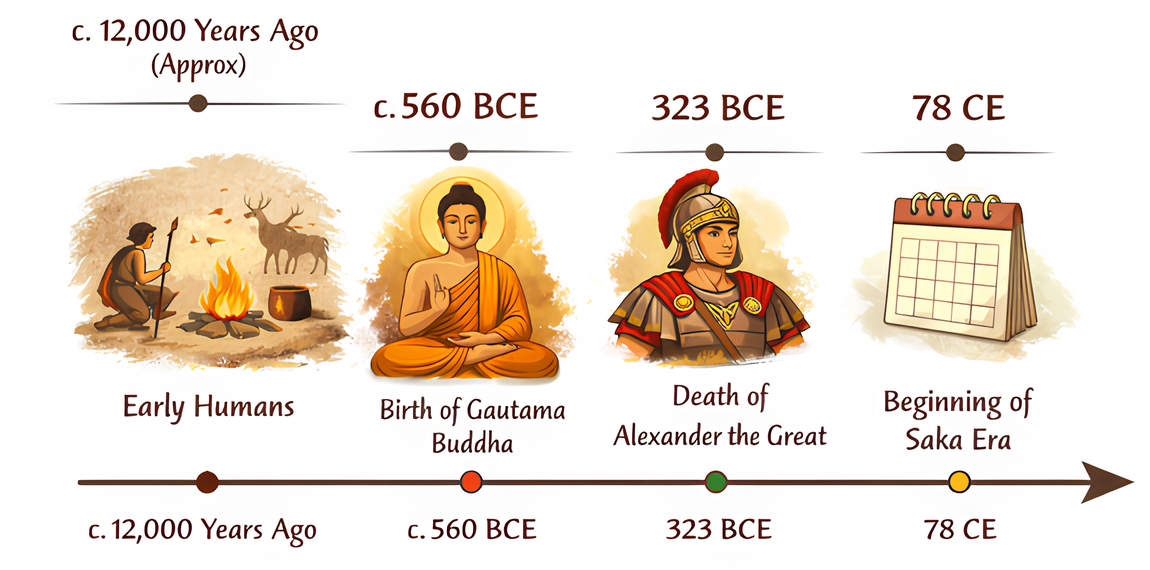
  • The Buddha was born around 560 BCE.

  • The time gap is approximately 879 years.


(c) Rani of Jhansi was born in 1828. Which century did she belong to? How many years was that before India’s Independence?

Answer:

  • 1828 CE falls in the 19th century CE.

  • India became independent in 1947 CE.

  • The difference is 119 years.


(d) Turn “12,000 years ago” into a date.

Answer:

  • Present year: 2024 CE

  • 12,000 years ago ≈ 9976 BCE


Question 4

Plan a visit to a nearby museum and write a brief report.

Answer: Museum Visit Report

Date of Visit: 15 September 2024
Museum Name: City Heritage Museum

Before visiting the museum, I researched the exhibits displayed there, as suggested in Class 6 History Chapter 4: Timeline and Sources of History. During the visit, I observed ancient tools, pottery, coins, sculptures, and manuscripts that showed how people lived in earlier times.

The most surprising part was the gallery of old weapons and jewellery, which showed excellent craftsmanship. Interactive digital displays made learning enjoyable, and the children’s activity section explained history in a simple and fun way. Seeing real historical objects helped me understand history better than textbooks alone.


Question 5

Invite to your school an archaeologist or a historian and ask them to speak on the history of your region and why it’s important to know it.

Answer: Invitation Letter

Sunrise Public School
Sector 5, Dwarka
New Delhi – 110075
Email: [email protected]

Date: 22 November 2024

To
Dr. Anil Sharma
Historian and Cultural Researcher
New Delhi

Dear Sir,

I hope this letter finds you well. I am writing on behalf of Sunrise Public School to invite you to interact with our students.

We would be grateful if you could speak on the history of our region and explain why understanding regional history is important. Learning about local history helps students appreciate cultural heritage and understand their roots.

Your talk would be highly informative and inspiring for our students. We would be honoured to have you share your knowledge and experiences with us.

Kindly let us know your availability.

Yours sincerely,
Aakash Mehta
Teacher (Social Science)
Sunrise Public School

Conclusion

This complete guide to Class 6 History Chapter 4: Timeline and Sources of History helps students understand historical concepts through real-life projects, timelines, and activities. If you found this helpful, share it with classmates, leave a comment, or explore the next chapter explanation for deeper learning 📘✨

RECENT POSTS

About the Author: Mission Gyan