
SSC CGL Syllabus 2026: Complete Tier 1 & Tier 2 Exam Pattern
The SSC CGL Syllabus 2026 is very important for candidates who want to prepare for the exam in the right direction. Therefore, before starting preparation, candidates should clearly understand the syllabus, exam pattern, marking scheme, and selection process.
The Staff Selection Commission conducts the Combined Graduate Level exam for different Group B and Group C posts. These posts are available in various government departments, ministries, and offices. As a result, lakhs of graduates appear for this exam every year.
Before making a study plan, candidates should know the latest SSC CGL exam pattern, subject-wise syllabus, negative marking, post-wise papers, and final merit process. Moreover, a clear understanding of these details helps candidates save time and focus on the most important topics.
In this article, candidates can check the complete SSC CGL Tier 1 syllabus, SSC CGL Tier 2 syllabus, exam pattern, negative marking, JSO syllabus, AAO syllabus, FAQs, and preparation tips in a simple and easy-to-read format.
Note: Candidates should also visit the official SSC website regularly for the latest notices, updates, and exam-related instructions.
Quick Summary
Here is a quick overview of the SSC CGL 2026 exam. This section will help candidates understand the main points before reading the detailed syllabus.
| Point | Details |
|---|---|
| Exam Stages | SSC CGL 2026 is conducted in Tier 1, Tier 2, and Document Verification stages. |
| Tier 1 Nature | Tier 1 is qualifying in nature. |
| Final Merit | Tier 2 marks are counted for final merit. |
| Interview | There is no interview in SSC CGL. |
| Tier 1 Subjects | Tier 1 includes Reasoning, Quantitative Aptitude, English, and General Awareness. |
| Tier 2 Subjects | Tier 2 includes Mathematical Abilities, Reasoning, English, General Awareness, Computer Knowledge, and post-specific papers. |
| Paper 2 | Paper 2 is for Junior Statistical Officer, JSO posts. |
| Paper 3 | Paper 3 is for Assistant Audit Officer / Assistant Accounts Officer posts. |
| Negative Marking | Negative marking applies in both Tier 1 and Tier 2. |
SSC CGL 2026: Basic Overview
SSC CGL 2026 is conducted through computer-based examinations. First, candidates appear for Tier 1. After qualifying this stage, they move to Tier 2. Finally, shortlisted candidates have to complete Document Verification.
Tier 1 is only qualifying in nature. However, Tier 2 is very important because its marks are used for the final merit list. Therefore, candidates should prepare Tier 2 with extra focus
| Particular | Details |
|---|---|
| Exam Name | SSC CGL |
| Full Form | Staff Selection Commission Combined Graduate Level |
| Question Type | Objective Type |
| Exam Mode | Computer-Based Test |
| Exam Stages | Tier 1, Tier 2, Document Verification |
| Exam Language | Hindi and English |
| Tier 1 Nature | Qualifying |
| Tier 2 Nature | Merit-based |
| Final Merit | Based on Tier 2 Marks |
| Interview | No Interview |
| Official Website | ssc.gov.in |
SSC CGL Selection Process 2026
The SSC CGL Selection Process 2026 includes three main stages. These are Tier 1, Tier 2, and Document Verification. Since there is no interview in SSC CGL, candidates should focus mainly on written exam performance.
First, candidates need to qualify Tier 1. Then, they appear for Tier 2. After that, selected candidates are called for Document Verification. Finally, the selection is made on the basis of Tier 2 marks and eligibility verification.
| Stage | Name | Nature |
|---|---|---|
| Tier 1 | Preliminary Examination | Qualifying |
| Tier 2 | Main Examination | Merit-based |
| Document Verification | Final Verification | Mandatory |
Key Points
- There is no interview round in SSC CGL.
- Candidates must qualify Tier 1 to appear in Tier 2.
- Tier 2 marks are counted for final merit.
- Document Verification is compulsory for final appointment.
- Candidates must satisfy the required eligibility conditions before final selection.
SSC CGL Tier 1 Exam Pattern 2026
The SSC CGL Tier 1 Exam 2026 is an objective-type computer-based test. It has four subjects: General Intelligence and Reasoning, Quantitative Aptitude, English Language, and General Awareness.
Each section carries 25 questions. Also, each section has 50 marks. In total, the exam has 100 questions for 200 marks. Candidates get 60 minutes to complete the paper.
There is negative marking in Tier 1. For every wrong answer, 0.50 mark is deducted. Therefore, candidates should avoid random guessing and focus on accuracy.
| Subject | Questions | Marks | Time |
|---|---|---|---|
| General Intelligence & Reasoning | 25 | 50 | 15 minutes |
| Quantitative Aptitude | 25 | 50 | 15 minutes |
| English Language | 25 | 50 | 15 minutes |
| General Awareness | 25 | 50 | 15 minutes |
| Total | 100 | 200 | 60 minutes |
SSC CGL Tier 1 Marking Scheme
| Particular | Details |
|---|---|
| Total Questions | 100 |
| Total Marks | 200 |
| Exam Duration | 60 minutes |
| Negative Marking | 0.50 mark for each wrong answer |
| Tier 1 | Qualifying only |
| Tier 1 Marks | Not included in final merit |
SSC CGL Tier 1 Syllabus 2026
The SSC CGL Tier 1 Syllabus 2026 is divided into four subjects. Each subject checks a different skill. For example, Reasoning checks logic, Quantitative Aptitude checks maths ability, English checks language skills, and General Awareness checks knowledge of current and static topics.
General Intelligence and Reasoning Syllabus
This section checks logical thinking, mental ability, and problem-solving skills. Moreover, it tests how quickly a candidate can understand patterns, directions, relationships, and conclusions.
Important Topics
| S.No. | Topic Name |
|---|---|
| 1 | Analogies |
| 2 | Similarities and differences |
| 3 | Space visualization |
| 4 | Spatial orientation |
| 5 | Problem-solving |
| 6 | Analysis and judgment |
| 7 | Blood relations |
| 8 | Decision making |
| 9 | Visual memory |
| 10 | Observation |
| 11 | Relationship concepts |
| 12 | Arithmetical reasoning |
| 13 | Figural classification |
| 14 | Number series |
| 15 | Non-verbal series |
| 16 | Coding-decoding |
| 17 | Statement and conclusion |
| 18 | Syllogistic reasoning |
Quantitative Aptitude Syllabus
This section checks basic maths skills, calculation speed, and concept clarity. Therefore, candidates should practise arithmetic, algebra, geometry, mensuration, trigonometry, and data interpretation regularly.
Important Topics
- Whole numbers
- Decimals and fractions
- Relationship between numbers
- Percentage
- Ratio and proportion
- Square roots
- Average
- Profit and loss
- Discount
- Partnership
- Mixture and alligation
- Simple and compound interest
- Time and work
- Time and distance
- Basic algebraic identities
- Elementary surds
- Graphs of linear equations
- Triangle and its centres
- Congruence and similarity of triangles
- Circle, chords, tangents, and angles
- Quadrilaterals and regular polygons
- Cone, cylinder, sphere, and hemisphere
- Rectangular parallelepiped
- Regular right pyramid
- Heights and distances
- Trigonometric ratios
- Standard trigonometric identities
- Histogram
- Frequency polygon
- Bar diagram
- Pie chart
English Language Syllabus
The English section tests grammar, vocabulary, sentence structure, and reading ability. In addition, candidates should practise comprehension, error spotting, cloze test, sentence improvement, and vocabulary-based questions daily.
Important Topics
- Idioms and phrases
- One-word substitution
- Sentence correction
- Error spotting
- Fill in the blanks
- Spelling correction
- Reading comprehension
- Synonyms and antonyms
- Active and passive voice
- Sentence rearrangement
- Sentence improvement
- Cloze test
General Awareness Syllabus
This section includes current affairs, static GK, general science, history, geography, economy, and important events. Therefore, regular reading and revision are very useful for this subject.
Important Topics
- India and neighbouring countries
- History
- Culture
- Geography
- Economy
- General policy
- Scientific research
- General science
- Current affairs
- Books and authors
- Sports
- Important government schemes
- Important days and dates
- Portfolio
- People in news
- Static GK
SSC CGL Tier 2 Exam Pattern 2026
SSC CGL Tier 2 is the main stage of the exam. Since Tier 2 marks are counted for final merit, candidates should give this stage more attention.
Paper 1 is compulsory for all candidates. However, Paper 2 and Paper 3 are post-specific. Paper 2 is for Junior Statistical Officer candidates, while Paper 3 is for Assistant Audit Officer and Assistant Accounts Officer posts.
There is negative marking in Tier 2 as well. In applicable sections, 1 mark is deducted for each wrong answer. Therefore, candidates should balance speed with accuracy.
| Paper | Section / Module | Subject | Questions | Marks | Duration |
|---|---|---|---|---|---|
| Paper 1 | Section 1 | Mathematical Abilities | 30 | 180 combined with Reasoning | 30 minutes |
| Paper 1 | Section 1 | Reasoning & General Intelligence | 30 | — | 30 minutes |
| Paper 1 | Section 2 | English Language & Comprehension | 45 | 210 combined with GA | 40 minutes |
| Paper 1 | Section 2 | General Awareness | 25 | — | 20 minutes |
| Paper 1 | Section 3 | Computer Knowledge | 20 | 60 | 15 minutes |
| Paper 1 | Section 4 | Data Entry Speed / Typing Test | — | Qualifying | 15 minutes |
| Paper 2 | — | Statistics | 100 | 200 | 2 hours |
| Paper 3 | — | General Studies: Finance & Economics | 100 | 200 | 2 hours |
Important Points for SSC CGL Tier 2
| S.No. | Important Point |
|---|---|
| 1 | Paper 1 is compulsory for all posts. |
| 2 | Paper 2 is only for candidates applying for Junior Statistical Officer, JSO. |
| 3 | Paper 3 is only for candidates shortlisted for Assistant Audit Officer or Assistant Accounts Officer posts. |
| 4 | Tier 2 marks are used for final merit. |
| 5 | There is negative marking in Tier 2. |
| 6 | In applicable sections, 1 mark is deducted for each wrong answer. |
SSC CGL Tier 2 Syllabus 2026
The SSC CGL Tier 2 Syllabus 2026 is more detailed than Tier 1. Hence, candidates should prepare with a proper timetable. Regular mock tests, revision, and previous year papers can improve performance.
Paper 1: Mathematical Abilities Syllabus
This section includes number system, arithmetic, algebra, geometry, mensuration, trigonometry, statistics, and probability. As a result, candidates should focus on both concepts and calculation speed.
| S.No. | Section | Topics |
|---|---|---|
| 1 | Number System | Whole numbers, decimals, fractions, relationship between numbers |
| 2 | Fundamental Arithmetic | Percentage, ratio and proportion, square roots, average, simple interest, compound interest, profit and loss, discount, partnership, mixture and alligation, time and distance, time and work |
| 3 | Algebra | Basic algebraic identities, elementary surds, graphs of linear equations |
| 4 | Geometry | Triangle and its centres, congruence and similarity of triangles, circle, chords, tangents, angles subtended by chords, common tangents |
| 5 | Mensuration | Triangle, quadrilaterals, regular polygons, circle, right prism, cone, cylinder, sphere, hemisphere, rectangular parallelepiped, regular right pyramid |
| 6 | Trigonometry | Trigonometric ratios, complementary angles, height and distance, standard identities |
| 7 | Statistics and Probability | Tables and graphs, histogram, frequency polygon, bar diagram, pie chart, mean, median, mode, standard deviation, simple probability |
Paper 1: Reasoning and General Intelligence Syllabus
This subject checks logical thinking, analytical ability, decision-making skills, and reasoning accuracy. Moreover, topics such as analogy, series, classification, coding-decoding, embedded figures, and Venn diagrams are important.
Important Topics
| S.No. | Topic Name |
|---|---|
| 1 | Semantic analogy |
| 2 | Symbolic operations |
| 3 | Symbolic and number analogy |
| 4 | Trends |
| 5 | Figural analogy |
| 6 | Space orientation |
| 7 | Semantic classification |
| 8 | Venn diagrams |
| 9 | Symbolic and number classification |
| 10 | Drawing inferences |
| 11 | Figural classification |
| 12 | Pattern folding and unfolding |
| 13 | Punched hole pattern |
| 14 | Semantic series |
| 15 | Figural pattern completion |
| 16 | Number series |
| 17 | Embedded figures |
| 18 | Figural series |
| 19 | Critical thinking |
| 20 | Problem solving |
| 21 | Emotional intelligence |
| 22 | Word building |
| 23 | Social intelligence |
| 24 | Coding-decoding |
| 25 | Numerical operations |
Paper 1: English Language and Comprehension Syllabus
This section tests grammar, vocabulary, sentence structure, reading skills, and comprehension ability. In addition, candidates may get passages based on stories, literature, current affairs, or editorial topics.
Important Topics
| S.No. | Topic Name |
|---|---|
| 1 | Vocabulary |
| 2 | Grammar |
| 3 | Sentence structure |
| 4 | Spotting errors |
| 5 | Fill in the blanks |
| 6 | Synonyms |
| 7 | Homonyms |
| 8 | Antonyms |
| 9 | Spelling and misspelt words |
| 10 | Idioms and phrases |
| 11 | One-word substitution |
| 12 | Sentence improvement |
| 13 | Active and passive voice |
| 14 | Direct and indirect narration |
| 15 | Sentence part shuffling |
| 16 | Sentence shuffling in passage |
| 17 | Cloze passage |
| 18 | Reading comprehension |
Paper 1: Computer Knowledge Syllabus
Computer Knowledge is also part of SSC CGL Tier 2. Therefore, candidates should not ignore this section. It includes computer basics, software, internet, email, networking, and cybersecurity topics.
| S.No. | Section | Topics |
|---|---|---|
| 1 | Computer Basics | Computer organisation, CPU, input and output devices, memory, backup devices, ports, Windows Explorer, keyboard shortcuts |
| 2 | Software Knowledge | Windows operating system basics, MS Word, MS Excel, PowerPoint |
| 3 | Internet and Email | Web browsing, searching, downloading, uploading, managing email accounts, e-banking |
| 4 | Networking and Cybersecurity | Networking devices, network protocols, information security threats, hacking, viruses, worms, Trojans, preventive security measures |
Paper 1: General Awareness Syllabus
The General Awareness section includes static GK, general studies, and current affairs. Hence, candidates should revise important facts and read daily updates regularly.
Important Topics
| S.No. | Topic Name |
|---|---|
| 1 | India and neighbouring countries |
| 2 | History |
| 3 | Culture |
| 4 | Geography |
| 5 | Economic scene |
| 6 | General policy |
| 7 | Scientific research |
| 8 | General science |
| 9 | Current affairs |
| 10 | Books and authors |
| 11 | Sports |
| 12 | Important schemes |
| 13 | Important days and dates |
| 14 | Portfolio |
| 15 | People in news |
Paper 2: Statistics Syllabus for JSO
Paper 2 is only for candidates applying for the Junior Statistical Officer post. Therefore, candidates who choose this post should prepare statistics topics carefully.
| Unit | Main Topics |
|---|---|
| Collection, Classification and Presentation of Data | Primary and secondary data, methods of data collection, tabulation, graphs, charts, frequency distribution |
| Measures of Central Tendency | Mean, median, mode, quartiles, deciles, percentiles |
| Measures of Dispersion | Range, quartile deviation, mean deviation, standard deviation, relative dispersion |
| Moments, Skewness and Kurtosis | Moments, relationship between moments, skewness, kurtosis |
| Correlation and Regression | Scatter diagram, correlation coefficient, regression lines, Spearman rank correlation, association of attributes, multiple and partial correlation |
| Probability Theory | Meaning, definitions, conditional probability, compound probability, independent events, Bayes’ theorem |
| Random Variable and Probability Distributions | Random variable, probability functions, expectation, variance, binomial, Poisson, normal, exponential distribution, joint distribution |
| Sampling Theory | Population, sample, parameter, statistic, sampling errors, non-sampling errors, sampling methods, sampling distribution, sample size |
| Statistical Inference | Point estimation, interval estimation, properties of good estimator, hypothesis testing, Z test, t test, chi-square test, F test, confidence interval |
| Analysis of Variance | One-way and two-way classified data |
| Time Series Analysis | Components of time series, trend determination, seasonal variation |
| Index Numbers | Meaning, construction, types, formulae, base shifting, splicing, cost of living index, uses |
Paper 3: General Studies, Finance and Economics Syllabus for AAO
Paper 3 is only for candidates shortlisted for Assistant Audit Officer or Assistant Accounts Officer posts. Therefore, candidates preparing for AAO-related posts should focus on Finance, Accounts, Economics, and Governance.
Part A: Finance and Accounts — 80 Marks
Part A includes Finance and Accounts topics. For example, candidates need to study financial accounting, accounting concepts, journal, ledger, trial balance, balance sheet, depreciation accounting, and related topics.
Financial Accounting
- Nature and scope of financial accounting
- Limitations of financial accounting
- Basic accounting concepts
- Accounting conventions
- Generally accepted accounting principles
Basic Concepts of Accounting
- Single entry system
- Double entry system
- Books of original entry
- Bank reconciliation
- Journal
- Ledger
- Trial balance
- Rectification of errors
- Manufacturing account
- Trading account
- Profit and loss appropriation account
- Balance sheet
- Capital and revenue expenditure
- Depreciation accounting
- Inventory valuation
- Accounts of non-profit organisations
- Receipts and payments account
- Income and expenditure account
- Bills of exchange
- Self-balancing ledgers
Part B: Economics and Governance — 120 Marks
Part B includes Economics and Governance topics. Moreover, this section covers CAG, Finance Commission, microeconomics, Indian economy, economic reforms, banking, fiscal policy, monetary policy, budget, and governance-related topics.
Important Topics
- Comptroller and Auditor General of India
- Constitutional provisions
- Role and responsibility of CAG
- Finance Commission
- Basic economics
- Microeconomics
- Definition and scope of economics
- Methods of economic study
- Central problems of an economy
- Production possibility curve
- Demand and supply
- Elasticity of demand and supply
- Consumer behaviour
- Marshallian approach
- Indifference curve approach
- Production and cost
- Market forms
- Price determination
- Indian economy
- Agriculture, industry, and services
- National income
- Population
- Poverty
- Unemployment
- Infrastructure
- Economic reforms since 1991
- Liberalisation
- Privatisation
- Globalisation
- Disinvestment
- Money and banking
- Monetary policy
- Fiscal policy
- Reserve Bank of India
- Commercial banks
- Regional Rural Banks
- Payment banks
- Budget
- Fiscal deficit
- Balance of payments
- FRBM Act, 2003
- Role of information technology in governance
SSC CGL Negative Marking 2026
Negative marking is an important part of the SSC CGL exam. In Tier 1, 0.50 mark is deducted for each wrong answer. Meanwhile, in Tier 2, 1 mark is deducted for each wrong answer in applicable sections.
Because of this, candidates should avoid guesswork. Instead, they should attempt questions carefully and focus on accuracy.
| Exam Stage | Negative Marking |
|---|---|
| Tier 1 | 0.50 mark for each wrong answer |
| Tier 2 | 1 mark for each wrong answer in applicable sections |
SSC CGL 2026 Preparation Tips
A smart preparation plan can help candidates complete the syllabus on time. Also, it can improve speed, accuracy, and confidence before the exam.
First, candidates should read the complete syllabus. Then, they should understand the exam pattern and marking scheme. After that, they can make a realistic timetable according to their strengths and weaknesses.
Moreover, regular practice is very important. Candidates should solve previous year papers, attempt mock tests, revise formulas, and analyse mistakes after every test. Finally, they should revise current affairs and static GK daily.
Best Preparation Tips
| S.No. | Preparation Tip |
|---|---|
| 1 | Read the complete SSC CGL syllabus before starting preparation. |
| 2 | Understand the latest exam pattern and marking scheme. |
| 3 | Make a realistic study timetable. |
| 4 | Give more time to weak subjects. |
| 5 | Revise formulas and grammar rules daily. |
| 6 | Practice previous year question papers. |
| 7 | Attempt mock tests regularly. |
| 8 | Analyse mistakes after every test. |
| 9 | Read current affairs and static GK daily. |
| 10 | Improve calculation speed for Quantitative Aptitude. |
| 11 | Focus on accuracy to avoid negative marking. |
| Q.No. | Question & Answer |
|---|---|
| Q1 | What is the SSC CGL Syllabus 2026? The SSC CGL Syllabus 2026 includes Reasoning, Quantitative Aptitude, English Language, General Awareness, Mathematical Abilities, Computer Knowledge, Statistics, Finance, and Economics, depending on the exam tier and post. |
| Q2 | What is the selection process for SSC CGL 2026? The SSC CGL selection process includes Tier 1, Tier 2, and Document Verification. Tier 1 is qualifying, while Tier 2 marks are used for final merit. |
| Q3 | Is there negative marking in SSC CGL 2026? Yes, there is negative marking. In Tier 1, 0.50 mark is deducted for each wrong answer. In Tier 2, 1 mark is deducted for each wrong answer in applicable sections. |
| Q4 | Are SSC CGL Tier 1 marks counted in final selection? No, Tier 1 marks are qualifying only. Final selection is based on marks scored in Tier 2. |
| Q5 | What are the subjects in SSC CGL Tier 1? SSC CGL Tier 1 includes General Intelligence and Reasoning, Quantitative Aptitude, English Language, and General Awareness. |
Conclusion
The SSC CGL Syllabus 2026 is the foundation of exam preparation. Therefore, candidates should understand the Tier 1 and Tier 2 exam pattern before starting their study plan.
Although Tier 1 is qualifying, it is still important because candidates must clear it to appear in Tier 2. On the other hand, Tier 2 is the main stage because its marks decide the final merit.
In conclusion, candidates should prepare with a clear strategy, practise mock tests regularly, revise important topics, and avoid guesswork. Also, they should keep checking the official SSC website for the latest updates.
Bookmark this page for quick revision and share it with other SSC CGL aspirants who are preparing for the 2026 exam.
RECENT POSTS
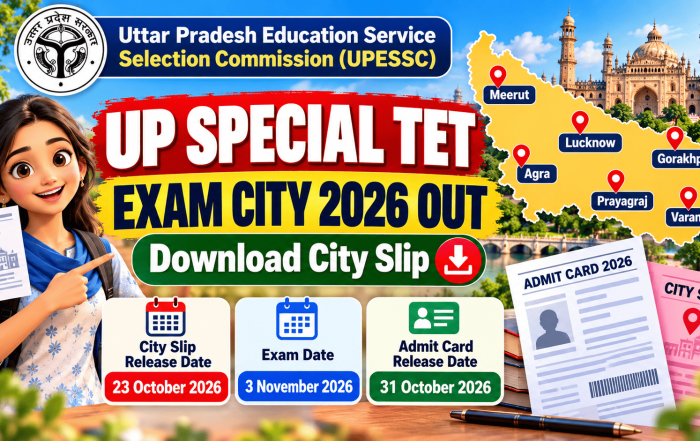
UP Special TET Exam City 2026 Out, Download City Slip
Mission Gyan2026-10-24T16:49:03+05:30October 24, 2026|0 Comments
UP Special TET Exam City 2026 Out, Download City Slip The Uttar Pradesh Education Service Selection Commission (UPESSC) released the UP Special TET Exam City 2026 slip on 23 October 2026. Candidates who applied under [...]
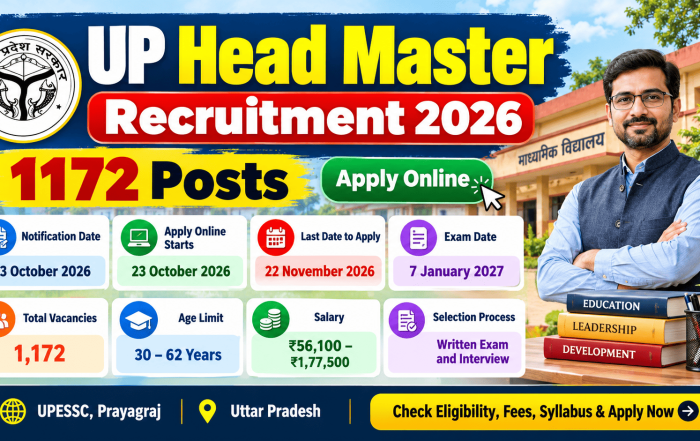
UP Head Master Recruitment 2026: 1172 Posts, Apply Online
Mission Gyan2026-10-24T15:47:04+05:30October 24, 2026|0 Comments
UP Head Master Recruitment 2026: 1172 Posts, Apply Online UP Head Master Recruitment 2026 notification has been released for 1,172 Head Master vacancies in Uttar Pradesh. The Uttar Pradesh Education Service Selection Commission (UPESSC), Prayagraj, [...]

DGMA Recruitment 2026: Apply Online for 30 MSA Posts
Mission Gyan2026-10-24T15:09:35+05:30October 24, 2026|1 Comment
DGMA Recruitment 2026: Apply Online for 30 MSA Posts DGMA Recruitment 2026 is open for 30 Management Support Associate (MSA) vacancies in Mumbai. The Directorate General of Maritime Administration (DGMA), under the Ministry of Ports, [...]
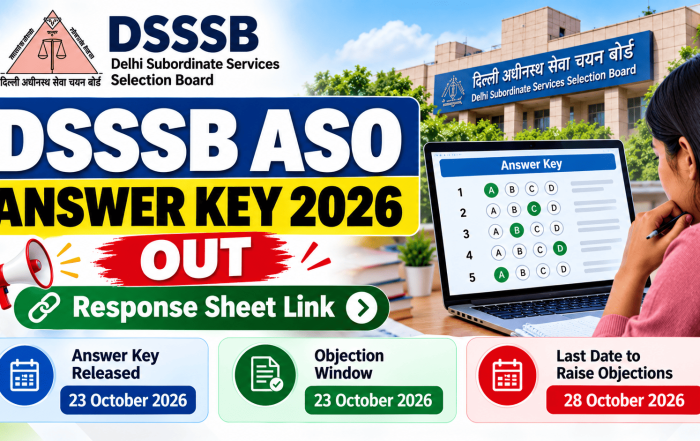
DSSSB ASO Answer Key 2026 Out, Response Sheet Link
Mission Gyan2026-10-24T14:19:08+05:30October 24, 2026|0 Comments
DSSSB ASO Answer Key 2026 Out, Response Sheet Link The DSSSB ASO Answer Key 2026 was released on 23 October 2026 by the Delhi Subordinate Services Selection Board (DSSSB). Candidates who appeared in the Grade-II/Assistant [...]
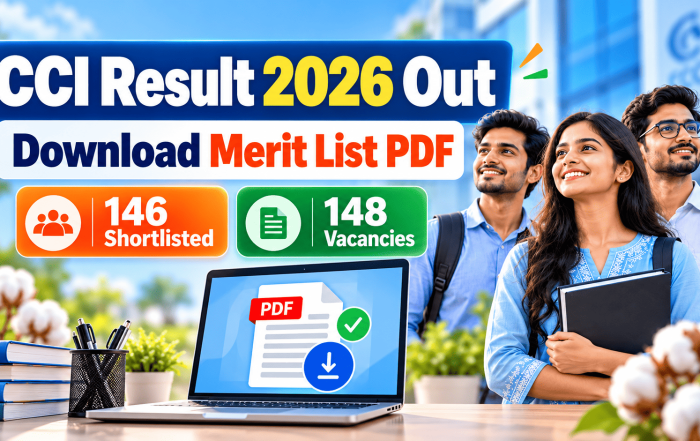
CCI Result 2026 Out: Download Merit List PDF
Mission Gyan2026-10-24T12:56:47+05:30October 24, 2026|0 Comments
CCI Result 2026 Out: Download Merit List PDF CCI Result 2026 was released on 23 October 2026 by the Cotton Corporation of India Limited (CCI). Candidates who appeared in the computer-based examination can now download [...]
UP TGT Notification 2026 Out: 17,735 Vacancies
Mission Gyan2026-10-24T12:23:35+05:30October 24, 2026|0 Comments
UP TGT Notification 2026 Out: 17,735 Teacher Vacancies UP TGT Notification 2026 Out: The Uttar Pradesh Education Service Selection Commission (UPESSC) has announced 17,735 Assistant Teacher vacancies in government-aided secondary schools across Uttar Pradesh. The [...]
UPESSC Principal Recruitment 2026: 1475 Posts
Mission Gyan2026-10-24T11:52:14+05:30October 24, 2026|0 Comments
UPESSC Principal Recruitment 2026: 1475 Posts UPESSC Principal Recruitment 2026 is now open for 1,475 Principal posts in aided schools across Uttar Pradesh. The Uttar Pradesh Education Service Selection Commission (UPESSC) released the notice on [...]
SSC GD Revised Result 2026 Out: Download Merit List
Mission Gyan2026-10-24T10:58:52+05:30October 24, 2026|0 Comments
SSC GD Revised Result 2026 Out: Download Merit List SSC GD Revised Result 2026 Out: The Staff Selection Commission (SSC) released the updated SSC GD Constable Result 2026 lists on 23 October 2026. Candidates can [...]
SSC GD Revised Result 2026 Out, Merit List PDF
Mission Gyan2026-10-23T16:50:29+05:30October 23, 2026|0 Comments
SSC GD Revised Result 2026 Out, Merit List PDF SSC GD Revised Result 2026 is out! The Staff Selection Commission (SSC) released updated merit lists on 23 October 2026. This update helps candidates understand their [...]
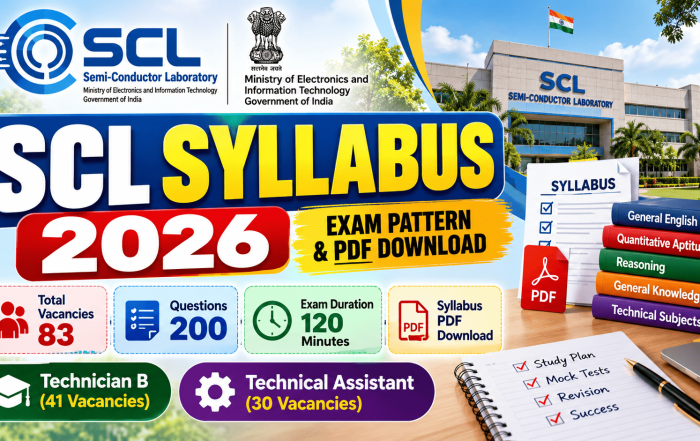
SCL Syllabus 2026: Exam Pattern & PDF Download
Mission Gyan2026-10-23T16:08:29+05:30October 23, 2026|0 Comments
SCL Syllabus 2026: Exam Pattern & PDF Download The SCL Syllabus 2026 is available in the official recruitment notification for Technician B and Technical Assistant posts. Candidates preparing for the Semi-Conductor Laboratory recruitment examination can [...]