ISRO Scientist Engineer Exam Date 2026, 175 Vacancies
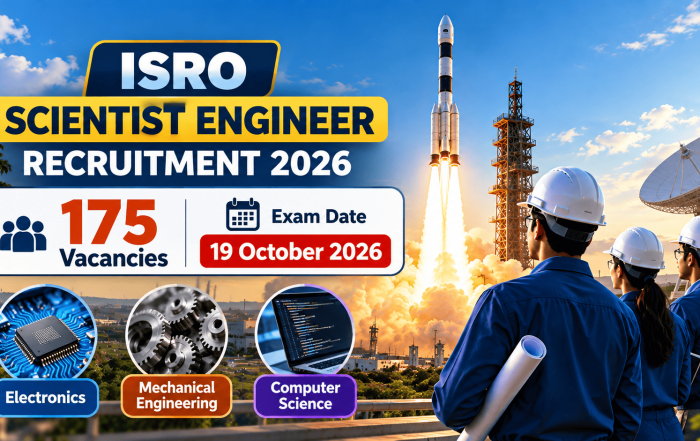
The Indian Space Research Organisation (ISRO) is conducting the ISRO Scientist Engineer Recruitment 2026 for 175 Scientist/Engineer ‘SC’ vacancies.
These posts are available in Electronics, Mechanical Engineering and Computer Science. Therefore, applicants should now focus on the upcoming CBT.
The ISRO Scientist Engineer Exam Date 2026 is 19 October 2026. Meanwhile, candidates should revise both technical and aptitude topics.
Selected candidates will join at Pay Matrix Level 10. In addition, the starting basic pay is ₹56,100 per month plus applicable allowances.
The ISRO Centralised Recruitment Board (ICRB) is handling the recruitment under Advertisement No. ISRO:ICRB:03(EMC):2026. As a result, applicants should follow official ISRO updates for this recruitment.
This article covers the exam date, vacancy, eligibility, age limit, exam pattern, salary, fee and selection process. Moreover, all key details are explained in simple language.
ISRO Scientist Engineer Exam Date 2026
ISRO will hold the Scientist/Engineer ‘SC’ Computer-Based Test on 19 October 2026. Therefore, applicants now have a fixed date for exam preparation.
ISRO Scientist Engineer CBT Exam Date: 19 October 2026
The CBT covers these three fields:
- Electronics
- Mechanical Engineering
- Computer Science
A total of 175 vacancies are available. Therefore, candidates should now focus on revision, practice and mock tests.
ISRO Scientist Engineer Recruitment 2026 Overview
The table below gives the main recruitment details.
| ParticularDetails | |
|---|
| Organisation | Indian Space Research Organisation |
| Short Name | ISRO |
| Recruitment Board | ISRO Centralised Recruitment Board |
| Recruitment Authority | ICRB |
| Post Name | Scientist/Engineer ‘SC’ |
| Advertisement Number | ISRO:ICRB:03(EMC):2026 |
| Total Vacancies | 175 |
| Application Mode | Online |
| Exam Mode | Computer-Based Test |
| Exam Date | 19 October 2026 |
| Maximum Age | 28 years |
| Age Cut-off Date | 16 September 2026 |
| Pay Level | Level 10 |
| Starting Basic Pay | ₹56,100 per month |
| Disciplines | Electronics, Mechanical and Computer Science |
| Official Website | ISRO |
The notification was released on 27 August 2026. However, the online application process ended on 16 September 2026.
Applications are now closed. Therefore, the CBT is the next major stage for applicants.
ISRO Scientist Engineer Recruitment 2026 Important Dates
Applicants can check all key dates below.
| EventDate | |
|---|
| Notification Release Date | 27 August 2026 |
| Online Application Start Date | 27 August 2026 |
| Last Date to Apply Online | 16 September 2026 |
| Application Closing Time | 11:55 PM |
| ISRO Scientist Engineer CBT Date | 19 October 2026 |
First, the application process started on 27 August 2026.
Later, it closed on 16 September 2026.
Meanwhile, the CBT is scheduled for 19 October 2026.
ISRO Scientist Engineer Vacancy 2026
ISRO has announced 175 Scientist/Engineer ‘SC’ vacancies. Moreover, Electronics has the highest number of posts.
Mechanical Engineering has the second-highest number of vacancies. In addition, Computer Science also has several openings.
ISRO Scientist Engineer Vacancy Distribution
| PostVacancies | |
|---|
| Scientist/Engineer ‘SC’ – Electronics | 99 |
| Scientist/Engineer ‘SC’ – Mechanical | 52 |
| Scientist/Engineer ‘SC’ – Computer Science | 21 |
| Scientist/Engineer ‘SC’ – Electronics, PRL | 1 |
| Scientist/Engineer ‘SC’ – Mechanical, PRL | 1 |
| Scientist/Engineer ‘SC’ – Computer Science, PRL | 1 |
| Total | 175 |
Overall, the recruitment includes 175 vacancies. However, the number may change if ISRO issues a later update.
ISRO Scientist Engineer Eligibility Criteria 2026
Applicants had to meet both education and age rules before applying. However, the required degree depends on the selected field.
Therefore, candidates should check the qualification for their post carefully.
Educational Qualification
Electronics
For Electronics posts, applicants need a B.E./B.Tech or equivalent degree in Electronics & Communication Engineering.
In addition, they need:
- At least 65% total marks, or
- At least 6.84 CGPA on a 10-point scale
Therefore, both the degree and marks should meet the required rules.
Mechanical Engineering
For Mechanical posts, applicants need a B.E./B.Tech or equivalent degree in Mechanical Engineering.
Moreover, they must have:
- At least 65% total marks, or
- At least 6.84 CGPA out of 10
Therefore, the degree should match the Mechanical post.
Computer Science
For Computer Science posts, applicants need a B.E./B.Tech or equivalent degree in Computer Science Engineering.
In addition, they should have:
- At least 65% marks, or
- At least 6.84 CGPA out of 10
Therefore, the engineering field should match the selected post.
ISRO Scientist Engineer Age Limit 2026
The maximum age limit is 28 years as on 16 September 2026.
However, eligible groups may receive age relaxation under Government of India rules.
For example, age relaxation may apply to:
- Serving Central Government civilian employees
- Ex-servicemen
- Persons with Benchmark Disabilities (PwBD)
Therefore, anyone claiming age relaxation should keep valid proof ready.
ISRO Scientist Engineer Selection Process 2026
The ISRO Scientist Engineer Selection Process 2026 includes a written exam and an interview.
First, candidates appear for the Computer-Based Test.
Next, eligible applicants are shortlisted for the interview.
Finally, written test and interview scores are used for final selection.
The main stages are:
- Computer-Based Test
- Shortlisting for Interview
- Interview
- Final Merit or Selection
- Document and eligibility checks, where required
Both stages are important. Therefore, applicants should prepare well for the exam and interview.
Final Selection Weightage
| Selection StageWeightage | |
|---|
| Written Examination | 50% |
| Interview | 50% |
| Total | 100% |
The written exam carries 50% weightage. Similarly, the interview carries 50% weightage.
As a result, strong performance in both stages is important.
ISRO Scientist Engineer Exam Pattern 2026
The ISRO Scientist Engineer Exam Pattern 2026 has two parts. Therefore, candidates should prepare for technical and aptitude questions.
| PartSubjectQuestionsMarksDuration | | | | |
|---|
| Part A | Technical/Area-Specific Questions | 80 | 80 | 90 Minutes |
| Part B | Aptitude/Ability Test | 15 | 20 | 30 Minutes |
| Total | — | 95 | 100 | 120 Minutes |
Overall, the exam carries 100 marks. In addition, candidates get 120 minutes to complete both parts.
Part A: Technical Test
Part A checks knowledge from the applicant’s engineering field.
For example, questions may come from:
- Electronics
- Mechanical Engineering
- Computer Science
This section has 80 questions for 80 marks. Moreover, applicants get 90 minutes to complete it.
Part A carries most of the marks. Therefore, technical subjects should get more study time.
Part B: Aptitude and Ability Test
Part B checks reasoning and problem-solving skills.
For example, questions may cover:
- Numerical reasoning
- Logical reasoning
- Diagrammatic reasoning
- Abstract reasoning
- Deductive reasoning
This section has 15 questions for 20 marks. Meanwhile, applicants get 30 minutes to complete it.
Regular practice can improve speed. As a result, accuracy may also improve.
ISRO Scientist Engineer Interview Marks 2026
Applicants who clear the written exam may be called for an interview. Moreover, the interview carries 100 marks.
Therefore, interview preparation is also important.
Interview Marks Distribution
| Interview AttributeMarks | |
|---|
| Technical/Academic Knowledge | 40 |
| Technical General Awareness Related to Specialisation | 20 |
| Presentation and Communication Skills | 20 |
| Comprehension | 10 |
| Academic Achievements | 10 |
| Total | 100 |
Technical and academic knowledge carries the highest marks. Therefore, shortlisted applicants should revise their main engineering subjects carefully.
Communication skills are also important. In addition, candidates should prepare for questions related to their field.
Academic Achievement Assessment
Academic marks may depend on:
- Type of educational institution
- Academic performance
- Institute ranking
- Other required academic factors
Moreover, the recruitment framework mentions IITs, IISc, IIST, NITs and eligible top-ranked institutes under the relevant NIRF rules.
Therefore, shortlisted applicants should keep their academic records ready.
ISRO Scientist Engineer Salary 2026
Selected Scientist/Engineer ‘SC’ candidates will join under Pay Matrix Level 10.
Moreover, the starting basic pay is ₹56,100 per month.
In addition, employees may receive several allowances under government rules.
ISRO Scientist Engineer Allowances and Benefits
Eligible employees may receive:
- Dearness Allowance
- House Rent Allowance
- Transport Allowance
- Medical facilities
- Subsidised canteen facilities
- Residential accommodation, subject to availability and rules
- Leave Travel Concession
- Group insurance
- House Building Advance
- Other allowed government benefits
However, the final monthly salary may vary. For example, the amount can change based on posting location, allowances and deductions.
Therefore, the final in-hand salary may differ from one employee to another.
ISRO Scientist Engineer Application Fee 2026
The application fee is ₹250.
However, applicants were initially required to pay a ₹750 processing fee.
In addition, eligible applicants may receive a refund under ISRO rules.
Therefore, refund conditions may differ by category and fee status.
Moreover, online payments are handled through the Bharatkosh e-Payment gateway.
As a result, applicants should keep their payment details safe.
How to Prepare for ISRO Scientist Engineer Exam 2026
The CBT will be held on 19 October 2026. Therefore, applicants should now follow a focused study plan.
First, revise the main engineering subjects.
Next, practise questions from important topics.
After that, take mock tests and check your mistakes.
A useful study plan includes:
- Revise basic engineering concepts
- Focus on field-specific subjects
- Practise numerical questions
- Solve technical questions regularly
- Prepare reasoning and aptitude for Part B
- Take timed mock tests
- Check mistakes after every test
- Revise formulas and short notes
- Improve speed and accuracy
- Use the final days mainly for revision
Part A carries 80 marks. Therefore, technical subjects should remain the main focus.
Part B adds another 20 marks. However, applicants should not ignore this section.
As a result, study time should be divided between technical and aptitude preparation.
Documents Applicants Should Keep Ready
Applicants who reach later stages should keep all key documents ready.
For example, they may need:
- Application form printout
- Admit card
- Valid photo ID
- Date of birth proof
- B.E./B.Tech degree certificate
- Semester or year-wise mark sheets
- Category certificate, if applicable
- PwBD certificate, if applicable
- Ex-serviceman documents, if applicable
- Government employee certificate or NOC, if required
- Recent passport-size photographs
- Other documents required by ISRO
Therefore, official instructions should be checked before each stage.
In addition, keeping documents ready can help avoid last-minute problems.
ISRO Scientist Engineer Recruitment 2026 FAQs
What is the ISRO Scientist Engineer Exam Date 2026?
The ISRO Scientist Engineer CBT is scheduled for 19 October 2026. Therefore, applicants should now focus on revision and mock tests.
How many vacancies are available in ISRO Scientist Engineer Recruitment 2026?
ISRO has announced 175 Scientist/Engineer ‘SC’ vacancies. Moreover, these posts are available in Electronics, Mechanical Engineering and Computer Science.
What is the selection process for ISRO Scientist Engineer 2026?
The selection process includes a Computer-Based Test followed by an interview. In addition, the written exam and interview each carry 50% weightage.
What qualification is required for ISRO Scientist Engineer Recruitment 2026?
Applicants need a relevant B.E./B.Tech or equivalent engineering degree. Moreover, they need at least 65% marks or 6.84 CGPA out of 10.
What is the age limit for ISRO Scientist Engineer 2026?
The maximum age is 28 years as on 16 September 2026. However, eligible applicants may receive age relaxation under Government of India rules.
Conclusion
The ISRO Scientist Engineer Recruitment 2026 offers 175 vacancies in Electronics, Mechanical Engineering and Computer Science.
Most importantly, the ISRO Scientist Engineer CBT will be held on 19 October 2026. Therefore, applicants should focus on technical revision, aptitude practice and mock tests.
In addition, important documents should be kept ready for later stages.
Finally, bookmark this page for updates on the ISRO Scientist Engineer Exam Date 2026, admit card, result and interview process. Also, share this article with other ISRO applicants preparing for the exam.