IBPS RRB PO Shift 2 Exam Analysis 2026: Good Attempts
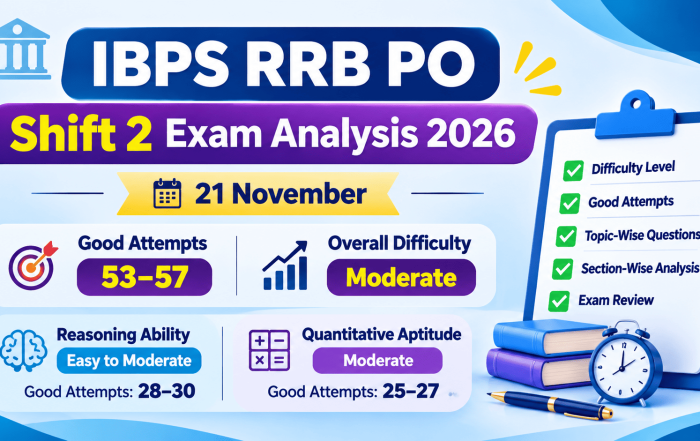
The IBPS RRB PO Shift 2 Exam Analysis 2026 for 21 November is out. According to the published examination review, the overall difficulty was moderate, and the estimated good attempts were 53–57 questions.
The Institute of Banking Personnel Selection (IBPS) conducted the second shift from 11:15 AM to 12:00 PM for Officer Scale I recruitment. The preliminary examination included 80 questions from Reasoning Ability and Quantitative Aptitude.
Candidates can check the section-wise difficulty level, good attempts, topic-wise questions, marking scheme, and preparation insights in this detailed review.
IBPS RRB PO Shift 2 Exam Analysis 2026: Highlights
Here are the key findings from the 21 November examination.
| Particulars | Details |
|---|
| Examination | IBPS RRB PO Prelims 2026 |
| Recruitment | CRP RRBs XV |
| Post | Officer Scale I |
| Exam Date | 21 November 2026 |
| Shift | Shift 2 |
| Timing | 11:15 AM–12:00 PM |
| Exam Mode | Online |
| Total Questions | 80 |
| Maximum Marks | 80 |
| Duration | 45 Minutes |
| Overall Difficulty | Moderate |
| Estimated Good Attempts | 53–57 |
The examination required candidates to balance speed and accuracy. Reasoning Ability was relatively manageable, while Quantitative Aptitude involved more calculations.
IBPS RRB PO Shift 2 Good Attempts and Difficulty Level
Good attempts help candidates assess their performance after an examination.
However, they are estimates based on paper difficulty and candidate feedback. They do not represent official qualifying marks.
Section-Wise Good Attempts
| Section | Questions | Difficulty Level | Good Attempts |
|---|
| Reasoning Ability | 40 | Easy to Moderate | 28–30 |
| Quantitative Aptitude | 40 | Moderate | 25–27 |
| Overall | 80 | Moderate | 53–57 |
The estimated range for Reasoning Ability was 28–30 questions. Meanwhile, Quantitative Aptitude had an estimated range of 25–27.
Candidates should also consider their incorrect answers before calculating an expected score.
IBPS RRB PO Shift 2 Reasoning Ability Analysis
Reasoning Ability contained 40 questions carrying 40 marks.
The section was rated easy to moderate. Puzzles and seating arrangements received the highest weightage, followed by inequality and Chinese Coding.
Reasoning Ability Topic-Wise Questions
| Topic | Questions |
|---|
| Puzzles and Seating Arrangements | 23 |
| Inequality | 5 |
| Chinese Coding | 5 |
| Direction and Distance | 3 |
| Number-Based Questions | 1 |
| Odd One Out | 1 |
| Meaningful Word | 1 |
| Pair Formation | 1 |
| Total | 40 |
Puzzles and seating arrangements accounted for 57.5% of the Reasoning Ability section.
Therefore, familiarity with arrangement-based questions was particularly useful.
Puzzles and Seating Arrangements Asked
Five arrangement-based sets were reported.
| Puzzle Type | Questions |
|---|
| Circular Seating Arrangement (In/Out) | 5 |
| Linear Seating Arrangement (Uncertain) | 3 |
| Linear Arrangement with Variables | 5 |
| Year-Based Puzzle (13 Years) | 5 |
| Box-Based Puzzle (9 Boxes) | 5 |
| Total | 23 |
These questions required candidates to organize information and identify relationships.
Although the reasoning section was comparatively manageable, some arrangement sets could still take considerable time.
Key Takeaways from Reasoning Ability
- Puzzles and seating arrangements dominated the section.
- Inequality and Chinese Coding contributed five questions each.
- Direction and Distance accounted for three questions.
- Smaller reasoning topics contributed four questions in total.
Candidates preparing for upcoming banking examinations should practise different arrangement patterns and improve logical accuracy.
IBPS RRB PO Shift 2 Quantitative Aptitude Analysis
Quantitative Aptitude was rated moderate.
According to the published review, candidates encountered calculation-intensive and time-consuming questions.
Data Interpretation and Arithmetic were prominent topics. The section also included Number Series, Approximation, and Quadratic Equations.
Quantitative Aptitude Topic-Wise Questions
| Topic | Reported Questions |
|---|
| Missing Number Series | 5 |
| Approximation | 3–4 |
| Quadratic Equations | 4–5 |
| Double Bar Graph DI | 5 |
| Caselet DI (Table-Based) | 5 |
| Pie Chart DI (Percentage-Based) | 5 |
| Arithmetic | 10–11 |
Data Interpretation Questions
Three Data Interpretation sets were reported:
- Double Bar Graph DI: 5 questions.
- Caselet DI: 5 questions.
- Pie Chart DI: 5 questions.
Together, these sets represented 15 questions.
Candidates needed to interpret the given data and perform calculations accurately.
Arithmetic and Other Topics
Arithmetic contributed approximately 10–11 questions.
Missing Number Series accounted for five questions, while Approximation and Quadratic Equations also appeared.
These topics tested numerical understanding, calculation speed, and problem-solving ability.
Key Takeaways from Quantitative Aptitude
- Data Interpretation had significant weightage.
- Arithmetic was another major topic.
- Calculations made the section relatively time-consuming.
- Numerical accuracy was important.
- Effective time management helped candidates avoid spending too long on individual questions.
For future preparation, students should strengthen their arithmetic concepts and practise timed DI sets.
IBPS RRB PO Shift 2 Exam Review: Which Section Was Harder?
The overall paper was moderate, with different challenges in each section.
Reasoning Ability: Easy to Moderate
Reasoning Ability contained several puzzle sets alongside shorter questions.
Candidates familiar with common reasoning patterns could approach these questions more efficiently.
Quantitative Aptitude: Moderate
Quantitative Aptitude required more numerical calculations.
Data Interpretation and Arithmetic contributed to the section’s time-consuming nature.
Was Shift 2 Harder Than Shift 1?
The published Career Power review assessed both shifts as moderate overall.
However, individual experiences may differ depending on preparation, accuracy, and question selection.
IBPS RRB PO Prelims Exam Pattern 2026
The official IBPS examination handout specifies 80 questions carrying 80 marks, with separate time limits for each section.
| Section | Questions | Marks | Duration |
|---|
| Reasoning Ability | 40 | 40 | 25 Minutes |
| Quantitative Aptitude | 40 | 40 | 20 Minutes |
| Total | 80 | 80 | 45 Minutes |
Candidates must qualify in both sections under the applicable cutoff requirements.
For additional recruitment information, read our
IBPS RRB Notification 2026 guide.
IBPS RRB PO Prelims Negative Marking
The preliminary examination follows a negative marking system.
| Response Type | Marks |
|---|
| Correct Answer | +1 |
| Incorrect Answer | −0.25 |
| Unattempted Question | 0 |
How to Calculate Your Expected Score
Use the following formula:
Expected Score = Correct Answers − (Incorrect Answers × 0.25)
For example, suppose a candidate attempted 70 questions:
- Correct answers: 60
- Incorrect answers: 10
- Unattempted questions: 10
The estimated score is:
60 − (10 × 0.25) = 57.50 marks
This example shows why accuracy matters alongside the total number of attempts.
Are 53–57 Good Attempts Enough to Qualify?
The reported good-attempt range of 53–57 questions can help candidates make an initial assessment.
However, it does not guarantee qualification.
The final outcome depends on:
- Actual marks obtained.
- Number of incorrect answers.
- State-wise and category-wise cutoffs.
- Sectional qualifying requirements.
- Applicable IBPS score-processing and selection rules.
Candidates should check official results and cutoffs rather than rely only on estimated good attempts.
For official information, visit the
IBPS website.
What Happens After IBPS RRB PO Prelims?
Candidates who qualify in the preliminary examination move to the next selection stage.
The recruitment process for Officer Scale I includes the Preliminary Examination, Main Examination, and Interview, followed by the applicable verification and selection formalities.
Main Examination
Shortlisted candidates appear for the Main Examination.
Interview
Candidates meeting the required Main Examination criteria proceed to the interview stage.
Final Selection
Final selection follows the official recruitment rules and prescribed performance requirements.
For additional information about Officer Scale I recruitment, visit our
IBPS RRB PO 2026 guide.
Preparation Tips Based on Shift 2 Analysis
The topic distribution provides practical insights for future banking aspirants.
Practise Different Puzzle Formats
Focus on circular seating, linear arrangements, box puzzles, and year-based problems.
Improve Data Interpretation Skills
Practise bar graphs, pie charts, percentage calculations, and caselet-based questions.
Strengthen Arithmetic
Revise numerical concepts regularly and solve problems within a fixed time limit.
Attempt Sectional Mock Tests
Use 25 minutes for Reasoning Ability and 20 minutes for Quantitative Aptitude.
This helps develop familiarity with the examination’s sectional timings.
Focus on Accuracy
Avoid unnecessary guessing and review mistakes after every mock test.
For a structured study plan, read our
Bank Exam Preparation Strategy 2026.
IBPS RRB PO Shift 2 Exam Analysis 2026: FAQs
Q1. What was the difficulty level of IBPS RRB PO Shift 2?
The overall difficulty was moderate. Reasoning Ability was easy to moderate, while Quantitative Aptitude was moderate.
Q2. What were the good attempts for Shift 2?
The estimated good attempts ranged from 53 to 57 questions overall.
Q3. How many questions were asked in the examination?
The examination contained 80 questions, with 40 each from Reasoning Ability and Quantitative Aptitude.
Q4. How many puzzles appeared in Shift 2?
A total of 23 questions were reported from puzzles and seating arrangements.
Q5. Which section was more time-consuming?
Quantitative Aptitude was relatively more time-consuming because of calculation-based questions.
Conclusion
The IBPS RRB PO Shift 2 Exam Analysis 2026 indicates that the 21 November examination was moderate overall.
Reasoning Ability was comparatively manageable, with puzzles and seating arrangements contributing the largest share of questions. Meanwhile, Quantitative Aptitude required greater calculation speed, particularly in Data Interpretation and Arithmetic.
The estimated 53–57 good attempts provide a useful benchmark. However, candidates should calculate their expected marks carefully and rely on official IBPS results for qualification information.