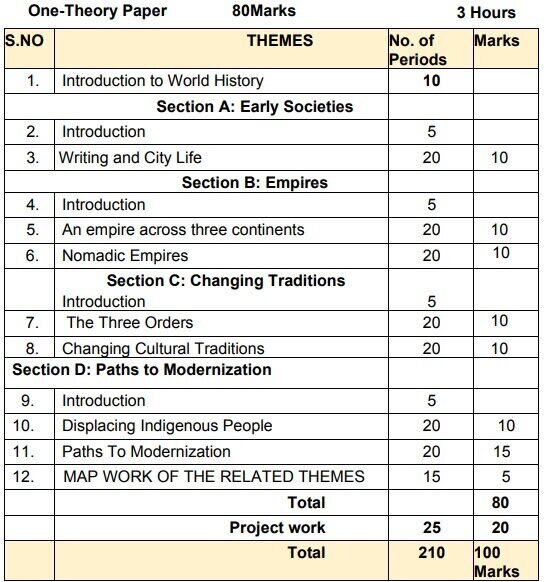
CBSE 11th Class Syllabus 2022-2023: The Central Board of Secondary Education (CBSE) has abandoned the term-wise examination system, which was implemented as a one-time scheme in the 2021-2022 school year. The board has announced the syllabus for classes 9th-12th for the current academic session (2022-2023) in accordance with the annual system of evaluation. As a result, students will now be obliged to prepare the entire syllabus for the annual examinations. Aside from that, there is one significant alteration in the syllabus’s substance. To alleviate the strain of a large syllabus on students, the board has rationalised the syllabus of practically all disciplines and deleted several chapters/topics.
Download CBSE Class 11th History Syllabus
CLASS-XI: THEMES IN WORLD HISTORY
THEMES
LEARNING OBJECTIVES
LEARNING OUTCOMES
Writing and City Life
Focus:Iraq, 3rd millennium BCE
a) Growth of towns
b) Nature of early urban societies
c) Historians’ Debate on uses of writing
● Familiarize the learner with the nature of early urban Centre’s.
● Discuss whether writing is significant as a marker of civilization.
At the completion of this unit students will be able to:
● Compare and analyze the transformation from Neolithic to Bronze Age Civilization in order to understand the myriad spheres of human development.
● Elucidate the interwoven social and cultural aspects of civilization in order to understand the connection between city life and culture of contemporary civilizations.
● Analyze the outcomes of a sustained tradition of writing.
An Empire across Three Continents
Focus: Roman Empire, 27 BCE to 600 CE
a) Political evolution
b) Economic Expansion
c) Religion-culture foundation
d) Late Antiquity
e) Historians’ view on the Institution of Slavery
● Familiarize the learner with the history of a major world empire
● Discuss whether slavery was a significant element in the economy.
At the completion of this unit students will be able to:
● Explain and relate the dynamics of the Roman Empire in order to understand their polity, economy, society and culture.
● Analyze the implications of Roman’s contacts with the subcontinent Empires
● Examine the domains of cultural transformation in that period
NOMADIC EMPIRES
Focus: The Mongol, 13th to 14th century
a) The nature of nomadism
b) Formation of empires
c) Conquests and relations with other states
Sd) Historians’ views on nomadic societies and state formation
• Familiarize the learner with the varieties of nomadic society and their institutions.
• Discuss whether state formation is possible in nomadic societies.
At the completion of this unit students will be able to:
• Identify the living patterns of nomadic pastoralist society.
• Trace the rise and growth of Genghis Khan in order to understand him as an oceanic ruler.
• Analyze socio-political and economic changes during the period of the descendants of Genghis Khan.
● Distinguish between the Mongolian people’s perspective and the world’s opinion about Genghis Khan
The Three Orders.
Focus: Western Europe 13th – 16th century a) Feudal society and economy b) Formation of state c) Church and society d) Historians’ views on decline of feudalism
● Familiarize the learner with the nature of the economy and society of this period and the changes within them.
● Show how the debate on the decline of feudalism helps in understanding processes of transition.
At the completion of this unit students will be able to:
● Explain the myriad aspects of feudalism with special reference to first, second, third and fourth order of the society.
● Relate between ancient slavery and serfdom
● Assess the 14th century crisis and rise of the nation states.
Changing Cultural Traditions
Focus: Europe 14th -17th century a) New ideas and new trends in literature and arts b) Relationship with earlier ideas c) The contribution of West Asia d) Historians’ viewpoint on the validity of the notion ‘European Renaissance
● Explore the intellectual trends in the period.
● Familiarize students with the paintings and buildings of the period.
● Introduce the debate around the idea of ‘Renaissance’.
At the completion of this unit students will be able to
● Analyze the causes, events, and effects of the Renaissance, Reformation, Scientific Revolution, and Age of Exploration.
● Relate the different facets of Italian cities to understand the characteristics of Renaissance Humanism and Realism.
● Compare and contrast the condition of women in the Renaissance period.
● Recognize major influences on the architectural, artistic, and literary developments in order to understand the facades of Renaissance.
● Critical analysis of the Roman Catholic Church by Martin Luther and Erasmus and their impact on later reforms.
● Evaluate the Roman Catholic Church’s response to the Protestant Reformation in the forms of the Counter and Catholic Reformations
Displacing Indigenous People
Focus:North America and Australia, 18th to 20th century
a) European colonists in North America and Australia
b) Formation of White Settler societies
c) Displacement and repression of local people
d) Historians’ viewpoint on the impact of European settlement on indigenous population
● Sensitize students to the processes of displacements that accompanied the development of America and Australia.
● Understand the implications of such processes for the displaced populations.
At the completion of this unit students will be able to
● Recount some aspects of the history of the native people of America to understand their condition.
● To analyze the realms of settlement of Europeans in Australia and America.
● Compare and contrast the lives and roles of indigenous people in these continents
Paths to Modernization
Focus:East Asia, late 19th to 20th century
a) Militarization and economic growth in Japan
b) China and the communist alternative
c) Historians’ Debate on the meaning of modernization
(NOTE- Keeping in view the importance of the themes i.e. Japan, China and Korea; it is advised that all must be taught in the schools)
● Make students aware that transformation in the modern world takes many different forms.
● Show how notions like ‘modernization’ need to be critically assessed.
At the completion of this unit students will be able to
● Deduce the histories of China and Japan from the phase of imperialism to modernization
● Explore the Japanese political, cultural and economic system prior to and after the Meiji Restoration.
● Analyze the domains of Japanese nationalism prior and after the Second World War.
● Summarize the nationalist upsurge in China from Dr Sun Yet Sen to Mao Ze Dong to understand the era of communism.
● To analyze the Chinese path to modernization under Deng Xio Ping and Zhou en Lai in order to understand the transformation from rigid communism to liberal socialism.
Conclusion
In conclusion, the CBSE Class 11 History syllabus covers a wide range of topics to provide students with a comprehensive understanding of ancient, medieval, and modern history. The syllabus aims to develop historical thinking, analytical skills, and a critical understanding of the past. By studying the syllabus, students will explore various aspects of Indian history, including ancient civilizations, medieval kingdoms, colonialism, and the Indian National Movement. Additionally, the syllabus incorporates significant events and developments from world history, such as the French Revolution, industrialization, nationalism in Europe, and the impact of imperialism.
FAQs
1.Is the CBSE Class 11 History syllabus the same for all schools?
The CBSE provides a standardized syllabus for all schools affiliated with the board. However, some minor variations or additional topics may be introduced by individual schools, so it’s best to consult your school or teachers for any specific differences.
2.What is the weightage of the CBSE Class 11 History exam?
The weightage of the History exam can vary depending on the evaluation scheme adopted by your school. It’s advisable to check with your school or refer to the CBSE guidelines for the specific weightage distribution of the exam.
3.Are there any practical components or projects in the CBSE Class 11 History syllabus?
The CBSE Class 11 History syllabus primarily focuses on theoretical knowledge and understanding of historical concepts. However, schools may incorporate practical components such as projects, research work, presentations, or field visits to enhance students’ learning experiences. Your school can provide specific information on any practical components included in the syllabus.
RPSC 1st Grade Question Paper 2026 PDF The RPSC 1st Grade Question Paper 2026 is one of the most useful resources for candidates appearing in the Rajasthan School Lecturer / 1st Grade Teacher examination. Candidates [...]
BSNL JTO Recruitment 2026 Bharat Sanchar Nigam Limited has released the BSNL JTO Recruitment 2026 notice for Junior Telecom Officer posts. A total of 100 posts are available for eligible candidates. The online form starts [...]
Bank of Baroda Peon Mains Result 2026 Latest Update: Bank of Baroda may release the Bank of Baroda Peon Mains Result 2026 in June 2026. Candidates who appeared in the mains exam can check their [...]
SBI Apprentice Apply Online 2026 The State Bank of India (SBI) has started the online application process for SBI Apprentice Recruitment 2026. Candidates who want to apply for the Apprentice post can submit their application [...]
SSC CGL Syllabus 2026: Complete Tier 1 & Tier 2 Exam Pattern The SSC CGL Syllabus 2026 is very important for candidates who want to prepare for the exam in the right direction. Therefore, before [...]
Indian Navy Agniveer Apprentice Recruitment 2026 The Indian Navy Agniveer Apprentice Recruitment 2026 notification has been released for the 01/2027 and 02/2027 batches. This is a useful opportunity for eligible candidates who want to join [...]
RUHS CUET BSc Nursing Result 2026 The RUHS CUET BSc Nursing Result 2026 is an important update for candidates who appeared in the Rajasthan University of Health Sciences Common Undergraduate Entrance Test. As per the [...]
RRB NTPC UG Admit Card 2026 Out The Railway Recruitment Board has released the RRB NTPC UG Admit Card 2026 for the Undergraduate CBT 1 exam. This exam is being held under CEN 07/2025. Candidates [...]
SSB Constable Tradesman Syllabus 2026 The SSB Constable Tradesman Syllabus 2026 is important for every candidate who wants to prepare for the Sashastra Seema Bal exam. Before starting the preparation, you should know the syllabus, [...]
RRB Technician Grade 3 Result 2026 Out The Railway Recruitment Board released the RRB Technician Grade 3 Result 2026 for different zones. Candidates who took the Technician Grade 3 CBT exam can now check their [...]