
SSC CGL 2026 Latest Exam Updates
The SSC CGL Syllabus 2026 is the first thing candidates should check before starting their preparation. As a result, a clear syllabus helps you choose the right topics, plan revision and practise according to the latest exam pattern.
The Staff Selection Commission conducts the Combined Graduate Level Examination to recruit graduates for several Group B and Group C posts in Central Government ministries, departments and organisations.
Overall, the 2026 selection process mainly includes Tier 1 and Tier 2 computer-based examinations.
In addition, SSC has introduced sectional timing in the latest pattern. Therefore, candidates need both speed and accuracy in every subject.
As per the official schedule, SSC CGL Tier 1 2026 is expected in August–September 2026. Meanwhile, Tier 2 is expected in December 2026.
In addition, this article explains the complete SSC CGL Syllabus 2026, Tier 1 and Tier 2 exam pattern, marking scheme, sectional timing, subject-wise syllabus, qualifying marks and preparation strategy.
SSC CGL Syllabus 2026 Overview
Before checking the detailed syllabus, candidates should understand the basic exam structure.
| Particular | Details |
|---|---|
| Exam Name | SSC Combined Graduate Level Examination 2026 |
| Conducting Authority | Staff Selection Commission |
| Exam Level | National Level |
| Minimum Qualification | Graduation |
| Exam Mode | Computer-Based Examination |
| Selection Stages | Tier 1 and Tier 2 |
| Questions in Tier 1 | 100 |
| Maximum Tier 1 Marks | 200 |
| Total Tier 1 Duration | 60 minutes |
| Sectional Time | 15 minutes per subject |
| Negative Marking | 0.50 mark per wrong answer |
| Tier 2 Papers | Paper I, Paper II and Paper III, as required |
| Official Website | ssc.gov.in |
SSC CGL Selection Process 2026
The SSC CGL Selection Process 2026 has two main stages.
- Tier 1 – Computer-Based Examination
- Tier 2 – Computer-Based Examination
In the first place, Tier 1 shortlists candidates for Tier 2.
However, SSC may prepare separate Tier 1 cut-offs for certain specific posts. These include Junior Statistical Officer, Statistical Investigator Grade II, Assistant Audit Officer and Assistant Accounts Officer.
After that, final selection mainly depends on the required Tier 2 performance.
Candidates must also qualify for the Computer Knowledge Test, DEST and other requirements for the chosen post.
SSC CGL Tier 1 Exam Pattern 2026
SSC CGL Tier 1 includes four subjects: General Intelligence and Reasoning, General Awareness, Quantitative Aptitude and English Comprehension.
Overall, the exam contains 100 questions for 200 marks.
SSC CGL Tier 1 Exam Pattern
| Subject | Questions | Marks | Time |
|---|---|---|---|
| General Intelligence & Reasoning | 25 | 50 | 15 minutes |
| General Awareness | 25 | 50 | 15 minutes |
| Quantitative Aptitude | 25 | 50 | 15 minutes |
| English Comprehension | 25 | 50 | 15 minutes |
| Total | 100 | 200 | 60 minutes |
In addition, each correct answer carries 2 marks.
Therefore, candidates can score a maximum of 200 marks.
SSC CGL Tier 1 Negative Marking
However, SSC applies negative marking in Tier 1.
For every wrong answer:
As a result, random guessing can reduce the final score.
Candidates should attempt doubtful questions only when they can eliminate some options.
SSC CGL Sectional Timing 2026
In particular, sectional timing is one of the biggest changes in the SSC CGL Exam Pattern 2026.
Specifically, each Tier 1 subject receives only 15 minutes. Therefore, the timing is: Reasoning – 15 minutes, General Awareness – 15 minutes, Quantitative Aptitude – 15 minutes and English – 15 minutes.
Earlier, candidates could manage the full 60 minutes according to their strengths.
Now, however, each subject has a separate timer.
Because of this change, candidates should practise subject-wise tests regularly.
For example, attempt a 15-minute Reasoning test instead of solving the section without a time limit.
As a result, this approach helps build real exam speed.
SSC CGL Tier 1 Syllabus 2026
The SSC CGL Tier 1 Syllabus 2026 covers four subjects.
These are Reasoning, General Awareness, Quantitative Aptitude and English Comprehension.
Let us check the syllabus subject by subject.
SSC CGL Reasoning Syllabus 2026
The Reasoning section tests logical thinking, observation, analytical ability and problem-solving skills.
Important topics include Analogies, Similarities and Differences, Semantic Analogy, Symbolic Analogy and Number Analogy. In addition, cover Figural Analogy, Semantic Classification, Symbolic Classification, Number Classification and Figural Classification.
Next, study Semantic Series, Number Series, Figural Series, Coding and Decoding and Word Building. Moreover, revise Numerical Operations, Symbolic Operations, Trends, Space Orientation and Spatial Visualisation.
Also, focus on Venn Diagrams, Drawing Inferences, Problem Solving, Critical Thinking and Decision Making. After that, review Judgment, Visual Memory, Observation, Discrimination and Relationship Concepts.
Similarly, practise Arithmetical Reasoning, Punched Hole, Pattern Folding, Pattern Unfolding and Figural Pattern Completion.
Finally, check Embedded Figures, Indexing, Address Matching, Date and City Matching and Centre Code Classification. In addition, cover Roll Number Classification, Small and Capital Letter Coding, Number Coding, Emotional Intelligence and Social Intelligence.
Moreover, candidates should practise both verbal and non-verbal reasoning.
In addition, they should focus on quick pattern recognition because the section has a fixed time limit.
SSC CGL General Awareness Syllabus 2026
The General Awareness section checks knowledge of current events and important static subjects.
It may include questions from History, Geography, Polity, Economics, Science and Current Affairs.
Current Affairs
Start by preparing National Current Affairs, International Current Affairs, Government Schemes, Important Appointments and Awards and Honours.
Next, study Books and Authors, Sports, Important Days, Major National Events and Major International Events.
For this reason, regular revision is important because current affairs change quickly.
History
Important areas include Ancient Indian History, Medieval Indian History, Modern Indian History, Indian National Movement and Freedom Struggle.
In addition, review Important Historical Events.
Geography
Start by studying Physical Geography, Indian Geography, World Geography, Climate and Rivers.
Also, focus on Mountains, Natural Resources, Agriculture and Population.
Indian Polity
Important topics include Constitution of India, Fundamental Rights, Fundamental Duties, Directive Principles and Parliament.
After that, review President, Prime Minister, Judiciary, Constitutional Bodies and Elections.
Finally, review Centre-State Relations.
Economics
Start by preparing Indian Economy, National Income, Inflation, Banking and Budget.
Finally, check Fiscal Policy, Monetary Policy, Poverty, Unemployment and Economic Reforms.
General Science
Questions may come from Physics, Chemistry, Biology, Human Body and Environment.
In addition, cover Everyday Science, Scientific Discoveries and Scientific Research.
Candidates should also study important facts about India and neighbouring countries.
SSC CGL Quantitative Aptitude Syllabus 2026
The Quantitative Aptitude section checks numerical ability and calculation skills.
It also tests how well candidates apply mathematical concepts.
Number System
Start with Whole Numbers, Decimals, Fractions, Relationship Between Numbers and Simplification.
Arithmetic
Important topics include Percentage, Ratio and Proportion, Square Roots, Average and Simple Interest.
Next, study Compound Interest, Profit and Loss, Discount, Partnership and Mixture and Alligation.
Finally, practise Time and Work and Time and Distance.
In particular, Arithmetic is one of the most important areas in SSC CGL Mathematics.
Therefore, candidates should practise calculations regularly.
Algebra
Start with Basic Algebraic Identities, Elementary Surds and Graphs of Linear Equations.
Geometry
Important topics include Triangle, Centres of a Triangle, Congruence, Similarity and Circle.
Also, focus on Chords, Tangents, Angles Subtended by Chords and Common Tangents to Circles.
Mensuration
For Mensuration, learn formulas for Triangle, Quadrilateral, Regular Polygon, Circle and Right Prism.
After that, review Right Circular Cone, Right Circular Cylinder, Sphere, Hemisphere and Rectangular Parallelepiped.
Finally, add Regular Right Pyramid.
Trigonometry
Start with Trigonometric Ratios, Degree and Radian Measures, Standard Identities, Complementary Angles and Heights and Distances.
Data Interpretation
For example, questions may use Tables, Bar Diagrams, Pie Charts, Histograms and Frequency Polygons.
In this case, speed matters in Quantitative Aptitude.
Therefore, candidates should practise short methods only after understanding the basic concepts.
SSC CGL English Syllabus 2026
The English section checks grammar, vocabulary, sentence usage and reading ability.
Important topics include Vocabulary, Grammar, Sentence Structure, Correct Usage of Words and Synonyms.
Next, check Antonyms, Homonyms, Spotting Errors, Fill in the Blanks and Spellings.
In addition, cover Detecting Misspelt Words, Idioms and Phrases, One-Word Substitution, Sentence Improvement and Active and Passive Voice.
After that, study Direct and Indirect Speech, Sentence Rearrangement, Shuffling of Sentence Parts, Cloze Test and Reading Comprehension.
Moreover, candidates should read English regularly.
Also, daily vocabulary revision can improve both speed and accuracy.
SSC CGL Tier 2 Exam Pattern 2026
The SSC CGL Tier 2 Exam Pattern 2026 may include three papers.
Your required paper depends on the post you choose.
Tier 2 Paper I
Paper I is compulsory for all candidates who qualify for Tier 2.
Tier 2 Paper II
Paper II covers Statistics.
It applies to candidates shortlisted for Junior Statistical Officer and Statistical Investigator Grade II.
Tier 2 Paper III
Paper III covers General Studies – Finance and Economics.
It applies to candidates shortlisted for Assistant Audit Officer and Assistant Accounts Officer.
Therefore, candidates should check their post preference carefully before planning Tier 2 preparation.
SSC CGL Tier 2 Paper I Exam Pattern
Paper I includes Mathematics, Reasoning, English, General Awareness, Computer Knowledge and DEST.
Tier 2 Section I
| Subject | Questions | Marks | Time |
|---|---|---|---|
| Mathematical Abilities | 30 | 90 | 30 minutes |
| Reasoning & General Intelligence | 30 | 90 | 30 minutes |
| Total | 60 | 180 | 60 minutes |
Both modules have separate timers.
Therefore, Mathematics gets 30 minutes, while Reasoning also gets 30 minutes.
Tier 2 Section II
| Subject | Questions | Marks | Time |
|---|---|---|---|
| English Language & Comprehension | 45 | 135 | 40 minutes |
| General Awareness | 25 | 75 | 20 minutes |
| Total | 70 | 210 | 60 minutes |
In particular, English carries the highest number of questions in this section.
As a result, strong English preparation can make a major difference in the final score.
Tier 2 Section III – Computer Knowledge Test
| Subject | Questions | Marks | Time |
|---|---|---|---|
| Computer Knowledge Test | 20 | 60 | 15 minutes |
Above all, the Computer Knowledge Test is mandatory.
However, it is only a qualifying test.
Still, candidates must meet the required pass standard.
Tier 2 Section IV – DEST
The Data Entry Speed Test is commonly called DEST.
Likewise, DEST is only a qualifying test.
Candidates generally need to complete about 2,000 key depressions in 15 minutes.
Therefore, regular typing practice is important.
SSC CGL Tier 2 Negative Marking
In contrast, negative marking in Tier 2 is higher than in Tier 1.
For Paper I, SSC deducts:
This rule applies to Mathematical Abilities, Reasoning and General Intelligence, English Language and Comprehension, General Awareness and Computer Knowledge Test.
Meanwhile, Paper II and Paper III carry:
DEST does not follow the normal MCQ marking system.
SSC CGL Tier 2 Mathematical Abilities Syllabus
The Mathematical Abilities syllabus covers Arithmetic, Algebra, Geometry, Mensuration, Trigonometry, Statistics and Probability.
Number Systems
Start with Whole Numbers, Decimals, Fractions and Relationship Between Numbers.
Arithmetic
Important chapters include Percentage, Ratio and Proportion, Square Roots, Average and Simple Interest.
Moreover, revise Compound Interest, Profit and Loss, Discount, Partnership and Mixture and Alligation.
Finally, practise Time and Distance and Time and Work.
Algebra
Start with Basic Algebraic Identities, Elementary Surds and Graphs of Linear Equations.
Geometry
Important topics include Triangle, Various Centres of a Triangle, Congruence, Similarity and Circle.
After that, review Chords, Tangents, Angles Subtended by Chords and Common Tangents.
Mensuration
For Mensuration, learn formulas for Triangle, Quadrilateral, Regular Polygons, Circle and Right Prism.
Next, review Right Circular Cone, Right Circular Cylinder, Sphere, Hemisphere and Rectangular Parallelepiped.
Finally, add Regular Right Pyramid.
Trigonometry
Important topics include Trigonometric Ratios, Degree and Radian Measures, Standard Identities, Complementary Angles and Heights and Distances.
Statistics and Probability
Start with Tables and Graphs, Histogram, Frequency Polygon, Bar Diagram and Pie Chart.
In addition, cover Mean, Median, Mode, Standard Deviation and Simple Probability.
SSC CGL Tier 2 Reasoning Syllabus
Important topics include Semantic Analogy, Symbolic Operations, Symbolic and Number Analogy, Trends and Figural Analogy.
Next, study Space Orientation, Semantic Classification, Venn Diagrams, Symbolic Classification and Number Classification.
Moreover, revise Drawing Inferences, Figural Classification, Punched-Hole Questions, Pattern Folding and Pattern Unfolding.
Also, focus on Semantic Series, Figural Pattern Completion, Number Series, Embedded Figures and Figural Series.
After that, review Critical Thinking, Problem Solving, Emotional Intelligence, Word Building and Social Intelligence.
Finally, practise Coding and Decoding and Numerical Operations.
Because of the fixed timer, candidates should practise this section with a stopwatch.
SSC CGL Tier 2 English Syllabus
Tier 2 English contains 45 questions for 135 marks.
Important topics include Vocabulary, English Grammar, Sentence Structure, Synonyms and Antonyms.
Next, check Correct Word Usage, Spotting Errors, Fill in the Blanks, Homonyms and Spellings.
In addition, cover Detecting Misspelt Words, Idioms and Phrases, One-Word Substitution, Sentence Improvement and Active and Passive Voice.
After that, study Direct and Indirect Speech, Shuffling of Sentence Parts, Sentence Rearrangement, Cloze Passage and Reading Comprehension.
In particular, English has a high weightage in Tier 2.
Therefore, candidates should aim for both speed and accuracy.
SSC CGL Tier 2 General Awareness Syllabus
General Awareness includes Current Affairs, Indian History, Indian Culture, Geography and Indian Economy.
Moreover, revise Indian Constitution, General Policy, Scientific Research, General Science and National Events.
Also, focus on International Events, Awards and Honours, Sports, Books and Authors and Important Organisations.
For this reason, revision is especially important for this subject.
Therefore, candidates should revise static GK and current affairs regularly.
SSC CGL Computer Knowledge Test Syllabus
The Computer Knowledge Test checks basic computer awareness.
It covers hardware, software, internet use, networking and cyber security.
Computer Fundamentals
Start with Organisation of a Computer, Central Processing Unit, Input Devices, Output Devices and Computer Memory.
After that, review Memory Organisation, Storage Devices, Backup Devices, Computer Ports and Windows Operating System.
Microsoft Office
Start by understanding MS Word, MS Excel and MS PowerPoint.
Common keyboard shortcuts may also help.
Internet and Email
Start with Internet Browsing, Web Searching, Downloading, Uploading and Email.
In addition, review Email Management and e-Banking Basics.
Networking
In particular, key concepts include Networking Devices, Networking Protocols and Basic Communication Networks.
Cyber Security
Start by understanding Viruses, Worms, Trojans, Malware and Hacking Threats.
Finally, check Computer Security, Safe Online Practices and Prevention of Cyber Attacks.
SSC CGL DEST 2026
The SSC CGL Data Entry Speed Test is conducted during Tier 2.
Candidates generally need to complete around 2,000 key depressions in 15 minutes.
Although DEST is qualifying, candidates should not ignore it.
As a result, regular typing practice can improve both speed and accuracy.
SSC CGL DEST Maximum Error Percentage
| Category | Maximum Error Percentage |
|---|---|
| UR | 20% |
| OBC / EWS | 25% |
| Other Categories | 30% |
Candidates should remember that SSC may set stricter standards for certain posts.
SSC CGL Tier 2 Paper II Statistics
Paper II is for candidates shortlisted for certain Statistics posts.
These include Junior Statistical Officer and Statistical Investigator Grade II.
SSC CGL Statistics Exam Pattern
| Particular | Details |
|---|---|
| Subject | Statistics |
| Questions | 100 |
| Maximum Marks | 200 |
| Duration | 2 hours |
| Negative Marking | 0.50 mark per wrong answer |
SSC CGL Statistics Syllabus 2026
Collection and Presentation of Data
Start with Primary Data, Secondary Data, Methods of Data Collection, Classification and Tabulation.
In addition, cover Frequency Distribution and Graphical Presentation.
Measures of Central Tendency
Important topics include Mean, Median, Mode, Quartiles and Deciles.
Next, study Percentiles.
Measures of Dispersion
Specifically, study Range, Quartile Deviation, Mean Deviation, Standard Deviation and Relative Measures of Dispersion.
Moments, Skewness and Kurtosis
Next, understand Moments, Skewness and Kurtosis.
Correlation and Regression
Start with Scatter Diagram, Simple Correlation, Karl Pearson’s Correlation Coefficient, Spearman’s Rank Correlation and Regression Lines.
In addition, review Regression Equations and Regression Coefficients.
Probability Theory
Important topics include Meaning of Probability, Definitions of Probability, Conditional Probability, Compound Probability and Independent Events.
Also, focus on Bayes’ Theorem.
Random Variables and Probability Distributions
Start with Random Variables, Probability Functions, Expectation, Variance and Binomial Distribution.
After that, review Poisson Distribution and Normal Distribution.
Sampling Theory
Important areas include Population and Sample, Sampling Methods, Random Sampling, Stratified Sampling and Systematic Sampling.
Similarly, practise Cluster Sampling, Sampling Errors and Non-Sampling Errors.
Statistical Inference
Start with Point Estimation, Interval Estimation, Testing of Hypotheses, Large Sample Tests and Small Sample Tests.
Finally, check Z-Test, t-Test, Chi-Square Test and F-Test.
Analysis of Variance
Start with One-Way Classification and Two-Way Classification.
Time Series Analysis
Important topics include Components of Time Series, Trend, Seasonal Variation and Methods of Measuring Trend.
Index Numbers
Start with Meaning of Index Numbers, Types of Index Numbers, Construction of Index Numbers and Base Shifting.
In addition, cover Cost of Living Index and Uses of Index Numbers.
SSC CGL Tier 2 Paper III Finance and Economics
Next, Paper III applies to candidates shortlisted for Assistant Audit Officer and Assistant Accounts Officer.
SSC CGL Finance and Economics Exam Pattern
| Particular | Details |
|---|---|
| Paper | General Studies – Finance and Economics |
| Questions | 100 |
| Maximum Marks | 200 |
| Duration | 2 hours |
| Negative Marking | 0.50 mark per wrong answer |
The syllabus has two main parts: Part A – Finance and Accounts and Part B – Economics and Governance.
Part A: Finance and Accounts Syllabus
Fundamental Principles of Accounting
Start by preparing Nature and Scope of Financial Accounting, Limitations of Financial Accounting, Accounting Concepts and Accounting Conventions.
Next, study Generally Accepted Accounting Principles.
Basic Accounting
Important topics include Single-Entry System, Double-Entry System, Books of Original Entry, Journal and Ledger.
Moreover, revise Trial Balance, Bank Reconciliation Statement, Rectification of Errors, Manufacturing Account and Trading Account.
Also, focus on Profit and Loss Account, Appropriation Account, Balance Sheet, Capital Expenditure and Revenue Expenditure.
After that, review Depreciation Accounting, Inventory Valuation, Non-Profit Organisation Accounts, Receipts and Payments Account and Income and Expenditure Account.
Finally, review Bills of Exchange and Self-Balancing Ledgers.
Part B: Economics and Governance Syllabus
Comptroller and Auditor General of India
Start with Constitutional Provisions, Role of CAG and Responsibilities of CAG.
Finance Commission
Begin by understanding Constitutional Position, Role and Major Functions.
Basic Economics and Microeconomics
Important topics include Definition of Economics, Nature and Scope of Economics, Methods of Economic Study and Central Problems of an Economy.
In addition, cover Production Possibility Curve.
Theory of Demand and Supply
Start with Meaning of Demand, Determinants of Demand, Law of Demand, Elasticity of Demand and Price Elasticity.
In addition, cover Income Elasticity, Cross Elasticity, Consumer Behaviour, Marshallian Approach and Indifference Curve Approach.
Next, study Meaning of Supply, Determinants of Supply, Law of Supply and Elasticity of Supply.
Theory of Production and Cost
Important topics include Factors of Production, Laws of Production, Law of Variable Proportions and Returns to Scale.
Forms of Market
Start with Perfect Competition, Monopoly, Monopolistic Competition, Oligopoly and Price Determination.
Indian Economy
Important areas include Nature of the Indian Economy, Agriculture Sector, Industrial Sector, Service Sector and Growth of Different Sectors.
In addition, review Problems of Different Sectors.
National Income
Start by understanding Concepts of National Income and Methods of Calculating National Income.
Population
Begin with Population Size, Population Growth and Population and Economic Growth.
Poverty and Unemployment
Important areas include Absolute Poverty, Relative Poverty, Types of Unemployment, Causes of Unemployment and Incidence of Unemployment.
Infrastructure
Focus on the role of Energy, Transport and Communication.
Economic Reforms Since 1991
Important areas include Liberalisation, Privatisation, Globalisation and Disinvestment.
Money and Banking
Start with Monetary Policy, Fiscal Policy, Reserve Bank of India, Functions of RBI and Commercial Banks.
In addition, cover Regional Rural Banks and Payment Banks.
Government Finance
Important topics include Government Budget, Fiscal Deficit, Balance of Payments and Fiscal Responsibility and Budget Management Act, 2003.
Information Technology and Governance
Candidates should understand the basic role of information technology in governance and public administration.
SSC CGL Minimum Qualifying Marks 2026
SSC sets minimum qualifying percentages for Tier 1 and the required Tier 2 sections.
| Category | Minimum Qualifying Marks |
|---|---|
| UR | 30% |
| OBC / EWS | 25% |
| Other Categories | 20% |
However, minimum qualifying marks are not the same as the final cut-off.
Candidates must also clear the actual SSC CGL cut-off.
For example, the cut-off may depend on the number of vacancies, number of candidates, category, difficulty level, post preference and overall performance.
Therefore, candidates should aim much higher than the minimum qualifying percentage.
SSC CGL Tier 1 vs Tier 2
The following table gives a quick comparison.
| Feature | Tier 1 | Tier 2 |
|---|---|---|
| Purpose | Shortlisting | Final merit and selection |
| Exam Mode | CBT | CBT |
| Reasoning | Yes | Yes |
| Mathematics | Yes | Yes |
| English | Yes | Yes |
| General Awareness | Yes | Yes |
| Computer Knowledge | No | Yes |
| DEST | No | Yes |
| Statistics | No | Selected posts |
| Finance & Economics | No | Selected posts |
| Tier 1 Negative Marking | 0.50 mark | — |
| Tier 2 Negative Marking | — | 1 mark in Paper I; 0.50 in Papers II and III |
| Sectional Timing | Yes | Yes |
SSC CGL Syllabus 2026 PDF
Candidates should always compare their preparation with the official SSC notification.
The SSC CGL Syllabus 2026 PDF can be checked through the official Staff Selection Commission website.
Official website:
Using the official notification is important because SSC may update exam dates, instructions or requirements for the chosen post.
Therefore, candidates should avoid depending only on coaching websites or social media posts.
Best Way to Prepare SSC CGL Syllabus 2026
A good preparation plan should focus on concepts, speed, accuracy and revision.
Start With Basic Concepts
First, strengthen your basics in Arithmetic, Algebra, Grammar, Vocabulary and Reasoning.
Strong concepts reduce mistakes.
Moreover, they help candidates solve questions faster.
Use Sectional Timers
Because SSC now uses sectional timing, practise under the same limits.
For Tier 1, begin with 15-minute Reasoning tests, 15-minute General Awareness tests, 15-minute Maths tests and 15-minute English tests.
This habit can improve exam confidence.
Solve Previous-Year Questions
SSC CGL previous-year papers are extremely useful.
For example, PYQs show Important Chapters, Repeated Concepts, Question Level, Common Reasoning Patterns and Vocabulary Trends.
In addition, they highlight Calculation-Based Topics.
Therefore, include PYQs in your daily schedule.
Take Mock Tests Regularly
Mock tests improve Speed, Accuracy, Time Management, Question Selection and Confidence.
However, simply attempting mock tests is not enough.
Candidates should review every mistake after the test.
Keep an Error Notebook
Write down Wrong Formulas, Grammar Mistakes, New Vocabulary, Difficult Reasoning Patterns and Current Affairs Facts.
In addition, note repeated calculation errors.
Then, revise this notebook every few days.
This simple method can reduce repeated mistakes.
Prepare Tier 2 Early
Do not wait for the Tier 1 result before starting Tier 2 preparation.
Tier 2 plays a major role in final selection.
Therefore, continue preparing Mathematics, Reasoning, English, General Awareness and Computer Knowledge.
Candidates targeting specific posts should also prepare Statistics or Finance and Economics early.
Practise DEST
DEST is qualifying.
Still, candidates should not ignore it.
Practise typing regularly and focus on Speed, Accuracy, Correct Spacing and Fewer Typing Errors.
Even 10 to 15 minutes of regular practice can help.
SSC CGL Syllabus 2026 FAQs
How many questions are asked in SSC CGL Tier 1?
SSC CGL Tier 1 contains 100 questions for 200 marks.
In addition, each subject has 25 questions.
What is the SSC CGL Tier 1 duration?
The total duration is 60 minutes.
However, each subject gets only 15 minutes.
Is there negative marking in SSC CGL Tier 1?
Yes. SSC deducts 0.50 mark for every incorrect answer.
Therefore, avoid blind guessing.
Which subjects are included in SSC CGL Tier 1?
Tier 1 includes Reasoning, General Awareness, Quantitative Aptitude and English Comprehension.
Is SSC CGL Tier 1 included in final merit?
In the first place, Tier 1 shortlists candidates for Tier 2.
Final merit mainly depends on the required Tier 2 performance and qualifying requirements.
Is SSC CGL Tier 2 compulsory?
Yes. Tier 2 Paper I is compulsory for candidates shortlisted for Tier 2.
However, Paper II and Paper III apply only to selected posts.
Who needs to appear for SSC CGL Statistics Paper?
Paper II applies to candidates shortlisted for Junior Statistical Officer and Statistical Investigator Grade II.
Who needs to appear for SSC CGL Paper III?
Paper III applies to candidates shortlisted for Assistant Audit Officer and Assistant Accounts Officer.
What is SSC CGL DEST?
DEST stands for Data Entry Speed Test.
Candidates generally need to complete around 2,000 key depressions in 15 minutes.
Conclusion
The SSC CGL Syllabus 2026 covers Reasoning, General Awareness, Quantitative Aptitude and English in Tier 1.
Meanwhile, Tier 2 includes Mathematical Abilities, Reasoning, English, General Awareness, Computer Knowledge and DEST.
In addition, candidates targeting specific posts may need to prepare Statistics or General Studies in Finance and Economics.
The latest SSC CGL Exam Pattern 2026 also includes sectional timing.
Therefore, candidates should focus on subject-wise speed instead of only overall exam speed.
First, complete the syllabus step by step. Next, solve previous-year papers and practise sectional tests. Finally, analyse mock-test mistakes and revise weak areas.
A balanced strategy of concepts, speed, accuracy and revision can greatly improve your SSC CGL score.
RECENT POSTS

CPRI Recruitment 2026: Apply Online for 110 Posts
Mission Gyan2026-09-19T17:10:42+05:30September 19, 2026|0 Comments
CPRI Recruitment 2026: Apply Online for 110 Posts CPRI Recruitment 2026 offers 110 vacancies for Engineering Officer Grade I, Engineering Assistant, Scientific Assistant, Technician Grade I, Technical Attendant Grade I, Assistant Grade II and Multi-Tasking [...]
RRB Paramedical Recruitment 2026: 590 Vacancies
Mission Gyan2026-09-19T16:26:30+05:30September 19, 2026|0 Comments
RRB Paramedical Recruitment 2026 RRB Paramedical Recruitment 2026 has been announced for 590 vacancies across nine paramedical categories in Indian Railways. The recruitment is being conducted by the Railway Recruitment Boards under CEN 05/2026. Eligible [...]
ISRO Scientist Engineer Exam Date 2026, 175 Vacancies
Mission Gyan2026-09-19T15:23:21+05:30September 19, 2026|0 Comments
ISRO Scientist Engineer Exam Date 2026, 175 Vacancies The Indian Space Research Organisation (ISRO) is conducting the ISRO Scientist Engineer Recruitment 2026 for 175 Scientist/Engineer ‘SC’ vacancies. These posts are available in Electronics, Mechanical Engineering [...]
IBPS RRB Apply Online 2026: 13,745 Posts, Last Date 21 Sep
Mission Gyan2026-09-19T12:51:47+05:30September 19, 2026|0 Comments
IBPS RRB Apply Online 2026: 13,745 Posts, Last Date 21 Sep The IBPS RRB Apply Online 2026 process is now open for Office Assistant and Officer posts. Eligible candidates can submit their forms online until [...]
AIIMS NORCET 11 Result 2026 Out, Download PDF
Mission Gyan2026-09-19T11:42:53+05:30September 19, 2026|1 Comment
AIIMS NORCET 11 Result 2026 Out, Download PDF The All India Institute of Medical Sciences (AIIMS), New Delhi announced the AIIMS NORCET 11 Result 2026 for Stage 1 on 18 September 2026. Candidates who took [...]
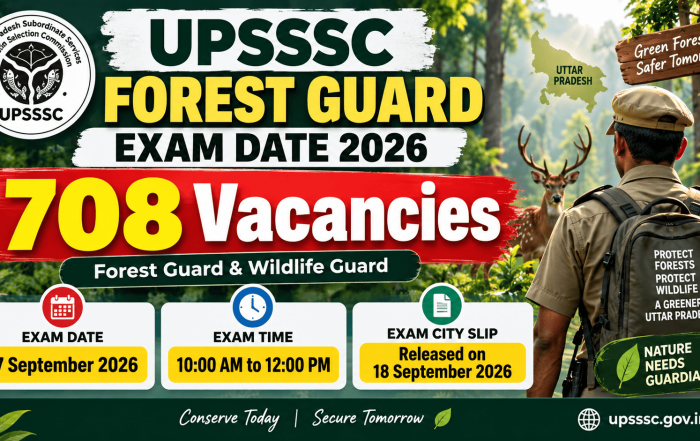
UPSSSC Forest Guard Exam Date 2026: 708 Vacancies
Mission Gyan2026-09-19T10:41:37+05:30September 19, 2026|0 Comments
UPSSSC Forest Guard Exam Date 2026: 708 Vacancies The Uttar Pradesh Subordinate Services Selection Commission (UPSSSC) has announced the UPSSSC Forest Guard Exam Date 2026 for candidates shortlisted for the Forest Guard and Wildlife Guard [...]
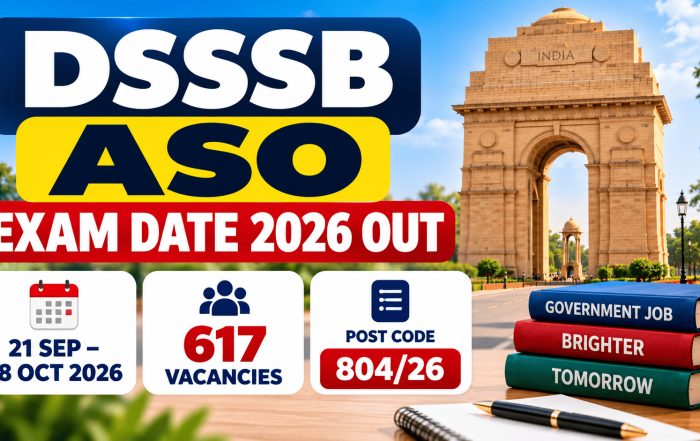
DSSSB ASO Exam Date 2026 Out: 617 ASO Vacancies
Mission Gyan2026-09-17T17:37:48+05:30September 17, 2026|0 Comments
DSSSB ASO Exam Date 2026 Out: 617 ASO Vacancies The DSSSB ASO Exam Date 2026 has been announced for Grade-II (GNCTDSS)/Assistant Section Officer candidates. The Delhi Subordinate Services Selection Board will conduct the DSSSB ASO [...]

RRB JE Exam Date 2026 Out: CBT 1 on 27, 28 & 30 Oct
Mission Gyan2026-09-17T16:09:48+05:30September 17, 2026|0 Comments
RRB JE Exam Date 2026: CBT 1 Schedule, Vacancies & Latest Update The RRB JE Exam Date 2026 is now available for candidates preparing for CBT 1 under CEN 04/2026. The Railway Recruitment Boards plan [...]
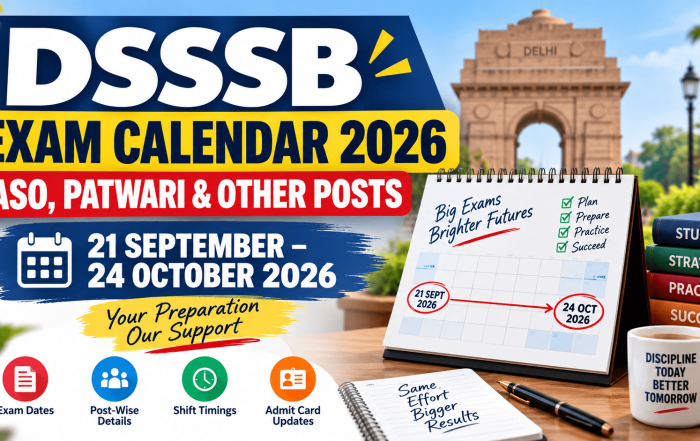
DSSSB Exam Calendar 2026 Out: ASO, Patwari Dates
Mission Gyan2026-09-17T15:16:21+05:30September 17, 2026|0 Comments
DSSSB Exam Calendar 2026 Out: ASO, Patwari Dates The DSSSB Exam Calendar 2026 is now available for Assistant Section Officer (ASO), Patwari, Assistant Manager, Statistical Clerk, Optometrist and several other posts. The Delhi Subordinate Services [...]
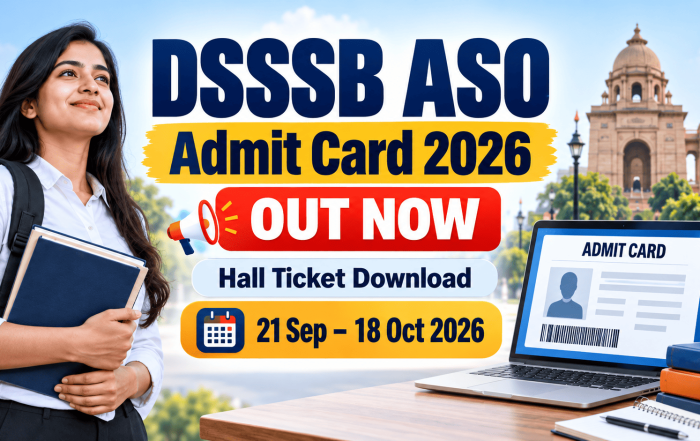
DSSSB ASO Admit Card 2026 Out, Download Hall Ticket
Mission Gyan2026-09-17T14:38:55+05:30September 17, 2026|0 Comments
DSSSB ASO Admit Card 2026 Out, Download Hall Ticket The DSSSB ASO Admit Card 2026 has been released on 17 September 2026 for candidates appearing in the upcoming examination. The Delhi Subordinate Services Selection Board [...]