
Rajasthan CET Graduation Level Syllabus 2026
Candidates preparing for the Rajasthan Common Eligibility Test can check the complete Rajasthan CET Graduation Level Syllabus 2026, examination pattern, subject-wise marks distribution and important OMR-sheet instructions here.
The Rajasthan CET Graduation Level Examination is conducted by the Rajasthan Staff Selection Board, Jaipur. According to the available information, the detailed syllabus and examination scheme have been released, while the recruitment notification is expected separately.
Candidates should study every section of the syllabus carefully and verify the latest instructions through the official RSSB website before beginning their final preparation.
Published:
18 June 2026
Conducting Authority:
Rajasthan Staff Selection Board, Jaipur
Rajasthan CET Graduation Level 2026 Overview
| Particular | Details |
|---|---|
| Conducting organization | Rajasthan Staff Selection Board, Jaipur |
| Examination name | Common Eligibility Test—Graduation Level |
| Examination year | 2026 |
| Job location | Rajasthan |
| Examination mode | Offline |
| Question type | Multiple-choice questions |
| Total questions | 150 |
| Maximum marks | 300 |
| Examination duration | 3 hours |
| Syllabus status | Stated as released |
| Official authority | Rajasthan Staff Selection Board |
Rajasthan CET Graduation Level 2026 Latest Update
The available article states that the syllabus and examination pattern for the Rajasthan CET Graduation Level Examination 2026 have been announced.
It also mentions the following changes:
- Negative marking will apply in the examination.
- The validity of the CET score or certificate has been extended from one year to three years.
- Candidates will be able to download the syllabus PDF from the relevant syllabus section.
- The examination will follow a five-option OMR-sheet system.
Candidates should treat these details as provisional until they have checked the latest official notification and syllabus PDF released by RSSB.
Rajasthan CET Graduation Level Exam Pattern 2026
The Rajasthan CET Graduation Level Examination will be conducted in offline mode. The question paper will contain objective-type multiple-choice questions.
The main examination details are:
New Five-Option OMR-Sheet Rules
Under the stated OMR-sheet system, candidates will receive five options for every question.
- Options A, B, C and D will represent the possible answers.
- Option E must be marked when a candidate does not wish to attempt a question.
- Candidates must mark one of the five available options.
- The article states that candidates who leave more than 10% of the questions without marking any option may be disqualified.
Candidates must read the OMR-sheet instructions given on the question paper and admit card carefully, as official examination-day rules will take priority.
Rajasthan CET Subject-Wise Marks Distribution
| Subject | Questions | Marks |
|---|---|---|
| General Science up to Class 10 level | 38 | 76 |
| Geography, History, Culture and Political System of Rajasthan | 30 | 60 |
| General English and Hindi | 22 | 44 |
| Mental Ability, Reasoning and Basic Numerical Ability | 45 | 90 |
| Basic Computer Knowledge | 15 | 30 |
| Total | 150 | 300 |
Rajasthan CET Graduation Level Syllabus 2026
The Rajasthan CET Graduation Level syllabus covers history, geography, polity, economics, science, reasoning, mathematics, languages, computer knowledge and current affairs.
The complete topic-wise syllabus is provided below.
1. History of Rajasthan and India
This section gives special importance to the Indian National Movement and Rajasthan’s role in political and social developments.
Important topics include:
- Major events in Indian history
- Social and religious reform movements of the nineteenth and twentieth centuries
- Different stages of the Indian freedom struggle
- Contributions of freedom fighters from different regions of India
- Rajasthan’s contribution to the Revolt of 1857
- Tribal movements in Rajasthan
- Peasant movements in Rajasthan
- Political awakening in Rajasthan
- Prajamandal movements
- Nation-building after independence
- National integration
- Reorganization of Indian states
- Institutional development during the Nehru period
- Development of science and technology
2. History, Art and Culture of Rajasthan
Candidates must study Rajasthan’s civilizations, dynasties, literature, architecture, folk traditions and cultural heritage.
The syllabus includes:
- Kalibangan civilization
- Ahar civilization
- Ganeshwar civilization
- Balathal civilization
- Bairat civilization
- Important historical events of Rajasthan
- Major ruling dynasties
- Administrative systems of Rajasthan’s dynasties
- Revenue systems of the ruling dynasties
- Social and cultural features of Rajasthan
- Major architectural styles
- Forts and monuments
- Paintings and handicrafts
- Important works of Rajasthani literature
- Regional dialects
- Fairs and festivals
- Folk music
- Folk dances
- Traditions and cultural heritage
- Religious movements
- Saints and folk deities
- Important historical places
- Major personalities of Rajasthan
- Integration of Rajasthan
3. Geography of India
The Indian Geography section covers physical features, climate, natural resources, agriculture, industries and transportation.
Candidates should prepare:
- Mountains, plateaus, deserts and plains
- Indian climate
- Monsoon system
- Major rivers
- Dams, lakes and seas
- Wildlife and sanctuaries
- Wheat, rice, cotton, sugarcane, tea and coffee
- Iron ore, manganese, bauxite and mica
- Conventional sources of energy
- Non-conventional sources of energy
- Major industries
- Important industrial regions
- National highways
- Means of transportation
- Trade
4. Geography of Rajasthan
This section examines the physical, climatic, agricultural, demographic and economic geography of Rajasthan.
Important topics are:
- Geological structure of Rajasthan
- Physiographic regions
- Climatic conditions
- Monsoon system
- Climatic regions
- Drainage system
- Lakes and dams
- Water-conservation techniques
- Natural vegetation
- Wildlife and sanctuaries
- Types of soil
- Major Rabi crops
- Major Kharif crops
- Population growth
- Population density
- Literacy rate
- Sex ratio
- Major tribes
- Metallic minerals
- Non-metallic minerals
- Conventional energy resources
- Non-conventional energy resources
- Tourist destinations
- National highways
- Railways
- Air transportation
5. Indian Political System and Rajasthan Administration
This part of the Rajasthan CET syllabus covers the Constitution of India, Union Government, constitutional bodies and Rajasthan’s political-administrative system.
Indian Constitution and Government
Candidates should study:
- Nature of the Indian Constitution
- Preamble
- Fundamental Rights
- Directive Principles of State Policy
- Fundamental Duties
- Federal structure
- Constitutional amendments
- Emergency provisions
- Public Interest Litigation
- Constituent Assembly
- Major features of the Constitution
- President of India
- Prime Minister and Council of Ministers
- Parliament
- Supreme Court
- Union and state executives
- Election Commission
- Comptroller and Auditor General
- Chief Information Commissioner
- Lokpal
- National Human Rights Commission
- Local self-government
- Panchayati Raj institutions
Political and Administrative System of Rajasthan
The Rajasthan-specific topics include:
- Governor
- Chief Minister
- State Legislative Assembly
- High Court
- Rajasthan Public Service Commission
- District administration
- State Human Rights Commission
- Lokayukta
- State Election Commission
- State Information Commission
6. Economy of India
The Indian Economy section includes important concepts related to banking, taxation, government policies, planning and economic development.
Candidates should prepare:
- Basic knowledge of budget preparation
- Banking
- Public finance
- Goods and Services Tax
- National income
- Economic growth
- Economic development
- Fiscal policy
- Monetary policy
- Subsidies
- Public Distribution System
- E-commerce
- Agriculture, industry, services and trade
- Current problems and government initiatives
- Green Revolution
- White Revolution
- Blue Revolution
- Five-Year Plans
- Planning system
- Major economic problems
- Government economic initiatives
- Economic reforms
- Liberalization
7. Economy of Rajasthan
This section focuses on Rajasthan’s agriculture, industries, development projects, employment, welfare programmes and rural development.
The syllabus includes:
- Food crops of Rajasthan
- Commercial crops
- Agriculture-based industries
- Major irrigation projects
- River-valley projects
- Wasteland-development projects
- Drought-area development programmes
- Indira Gandhi Canal Project
- Location and development of industries
- Mineral-based industries
- Small-scale industries
- Cottage industries
- Village industries
- Export products
- Rajasthani handicrafts
- Poverty and unemployment
- Types and causes of poverty
- Causes of unemployment
- Measures for reducing poverty and unemployment
- Current flagship schemes
- Social justice and empowerment
- Provisions for weaker sections
- Welfare schemes
- Mahatma Gandhi National Rural Employment Guarantee Act
- Development institutions
- Cooperative movement
- Small enterprises
- Financial institutions
- Role of Panchayati Raj institutions in rural development
- Provisions of the 73rd Constitutional Amendment
8. Science and Technology
The Science and Technology section includes physics, chemistry, biology, environment, health, agriculture and technological development.
Important topics include:
- Information and communication technology
- Defence technology
- Space technology
- Satellites
- Electric current
- Heat
- Work and energy
- Food and nutrition
- Blood groups
- Rh factor
- Healthcare
- Communicable diseases
- Non-communicable diseases
- Zoonotic diseases
- Environmental changes
- Ecological changes and their effects
- Biodiversity
- Conservation of natural resources
- Sustainable development
- Economic importance of animals and plants
- Agricultural science
- Horticulture
- Forestry
- Animal husbandry, with special reference to Rajasthan
- Scientific development in Rajasthan
- Technological development in Rajasthan
- Physical changes
- Chemical changes
- Acids, bases and salts
- Bleaching powder
- Baking soda
- Plaster of Paris
- Soaps and detergents
9. Logical Reasoning, Mental Ability and Mathematics
This section tests analytical ability, decision-making, logical thinking and basic numerical skills.
Reasoning and Mental Ability
Candidates should prepare:
- Number and letter series
- Analogies
- Figure-matrix questions
- Classification
- Alphabet tests
- Passages and conclusions
- Blood relations
- Coding and decoding
- Direction-sense tests
- Seating arrangements
- Input and output
- Number ranking
- Time-related problems
- Decision-making
- Logical arrangement of words
- Missing characters
- Missing numbers
- Mathematical operations
Basic Mathematics
The mathematics syllabus includes:
- Average
- Ratio and proportion
- Percentage
- Unitary method
- Profit and loss
- Simple interest
- Compound interest
- Area of triangles
- Area of circles
- Area of ellipses
- Area of trapeziums
- Area of rectangles
- Surface-related questions involving spheres and cylinders
- Volume of spheres
- Volume of cylinders
- Volume of cubes
- Volume of cones
10. Hindi Language Knowledge
The Hindi section evaluates grammar, vocabulary, sentence correction, translation terminology and official letter-writing knowledge.
Topics include:
- General Hindi
- Sandhi and Sandhi separation
- Nouns
- Pronouns
- Adjectives
- Verbs
- Adverbs
- Case relations
- Indeclinable words
- Compounds and their types
- Formation and analysis of compound words
- Prefixes
- Suffixes
- Antonyms
- Synonyms
- Words with multiple meanings
- Punctuation marks
- Sounds and their classification
- Technical terminology
- Hindi equivalents of English technical terms
- Correction of incorrect words
- Correction of incorrect sentences and phrases
- Idioms and proverbs
- Constitutional status of Hindi as an official language
- Types of letters
- Format of official letters
11. General English
The General English section covers grammar, vocabulary, comprehension, translation and official communication.
Candidates should study:
- Articles
- Determiners
- Tenses
- Sequence of tenses
- Active and passive voice
- Direct and indirect narration
- Prepositions
- Translation of English sentences into Hindi
- Translation of Hindi sentences into English
- Synonyms
- Antonyms
- Reading comprehension
- Official and technical terminology
- Hindi equivalents of technical English terms
- Official letters
- Demi-official letters
- Circulars
- Notices
- Objective questions based on letter formats
- Idioms and phrases
- One-word substitution
12. Basic Computer Knowledge
The computer section tests fundamental knowledge of computer systems, memory, software and Microsoft Office applications.
Important topics include:
- Characteristics of computers
- Computer organization
- Random Access Memory
- Read-Only Memory
- File systems
- Input devices
- Computer software
- Relationship between hardware and software
- Operating systems
- Microsoft Word
- Microsoft Excel
- Spreadsheets
- Microsoft PowerPoint
13. Current Affairs
Candidates should remain informed about important developments at the state, national and international levels.
The Current Affairs syllabus includes:
- Major events and issues related to Rajasthan
- Important national developments
- International events of importance
- Persons currently in the news
- Places and institutions in the news
- Sports
- Sports-related activities
How to Download the Rajasthan CET Syllabus PDF
Candidates can follow these steps to find the Rajasthan CET Graduation Level syllabus on the official RSSB website:
- 1
Visit the official website of the Rajasthan Staff Selection Board. - 2
Locate the Candidate Corner section on the homepage. - 3
Select the Syllabus option. - 4
Search for the Rajasthan CET Graduation Level syllabus link. - 5
Open the relevant syllabus PDF. - 6
Review all topics and examination instructions. - 7
Download or print the document for future reference. - 8
Prepare according to the latest official syllabus and examination pattern.
Useful Rajasthan CET Preparation Resources
Candidates may also look for the following resources while preparing:
- Rajasthan CET Graduation Level syllabus PDF
- CET examination-date notice
- Previous-year question papers
- Official answer keys
- Rajasthan government recruitment updates
- RSSB official notifications
- Examination-related update groups
Always prefer official notifications and documents over information circulated through unofficial groups or third-party sources.
Rajasthan CET Graduation Level Preparation Tips
Candidates can use the syllabus more effectively by following a structured preparation plan.
- Review the complete syllabus before selecting study materials.
- Give more time to sections carrying a higher number of marks.
- Prepare Rajasthan history, geography, culture and administration carefully.
- Practise reasoning and numerical-ability questions regularly.
- Revise Hindi and English grammar rules.
- Improve practical knowledge of Microsoft Word, Excel and PowerPoint.
- Read current affairs related to Rajasthan, India, international events and sports.
- Solve previous question papers within the prescribed three-hour duration.
- Practise filling out sample OMR sheets accurately.
- Check official RSSB notices frequently for changes in the examination rules.
Frequently Asked Questions
Has the Rajasthan CET Graduation Level Syllabus 2026 been released?
The source article states that the syllabus and examination pattern have been released. Candidates should confirm the availability of the official 2026 PDF through the Rajasthan Staff Selection Board website.
How many questions will be asked in the CET examination?
According to the stated examination pattern, the paper will contain 150 objective-type questions.
What are the maximum marks for the examination?
The Rajasthan CET Graduation Level paper will carry a maximum of 300 marks.
What is the duration of the CET Graduation Level examination?
Candidates will receive three hours to complete the examination.
Will there be negative marking?
The available article states that negative marking will apply. Candidates should check the official notification for the exact deduction rule.
What is Option E on the OMR sheet?
Option E is intended for candidates who decide not to attempt a question. Under the stated system, candidates must mark one of the five options for each question.
Important Accuracy Notice
The referenced webpage presents the information as the Rajasthan CET Graduation Level Syllabus 2026. However, the official RSSB syllabus listing identified during the earlier verification prominently displayed the Graduation Level CET scheme and syllabus for the 2024 examination.
A separate RSSB press note dated 18 June 2026 reportedly concerns the examination dates for the 2026 Senior Secondary and Graduation Level CET examinations.
Therefore, candidates should confirm whether RSSB has uploaded a separately revised syllabus PDF for the 2026 examination. The official notification, syllabus and examination instructions should always be treated as final.
Conclusion
The Rajasthan CET Graduation Level Syllabus 2026 covers a wide range of subjects, including Rajasthan history and culture, Indian polity, geography, economics, science, reasoning, mathematics, languages, computers and current affairs.
Download the latest official syllabus, create a subject-wise study plan and begin regular revision early. Share this guide with other CET aspirants and check the RSSB website frequently for official updates.
RECENT POSTS
IFFCO AGT Syllabus 2026 & Exam Pattern
Mission Gyan2026-10-02T14:31:36+05:30October 2, 2026|0 Comments
IFFCO AGT Syllabus 2026 & Exam Pattern The IFFCO AGT Syllabus 2026 is one of the most important resources for candidates preparing for the Agriculture Graduate Trainee examination conducted by Indian Farmers Fertiliser Cooperative Limited. [...]

IFFCO AGT Recruitment 2026: Apply Online, ₹33,300 Stipend
Mission Gyan2026-10-02T11:24:57+05:30October 2, 2026|0 Comments
IFFCO AGT Recruitment 2026: Apply Online, ₹33,300 Stipend IFFCO AGT Recruitment 2026 has been announced for eligible B.Sc. Agriculture graduates. Indian Farmers Fertiliser Cooperative Limited is accepting online applications for the post of Agriculture Graduate [...]
IBPS RRB Clerk 2nd Reserve List 2026 Out, Check Status
Mission Gyan2026-10-01T17:01:05+05:30October 1, 2026|0 Comments
IBPS RRB Clerk 2nd Reserve List 2026 Out, Check Status The IBPS RRB Clerk 2nd Reserve List 2026 is now available for candidates waiting for allotment under CRP-RRBs-XIV. The Institute of Banking Personnel Selection released [...]
SCI Junior Court Assistant Cut Off 2026, Previous Year Marks
Mission Gyan2026-10-01T16:10:52+05:30October 1, 2026|1 Comment
SCI Junior Court Assistant Cut Off 2026 The SCI Junior Court Assistant Cut Off 2026 will help candidates understand the minimum score needed to qualify for the next stage of recruitment. The Supreme Court of [...]
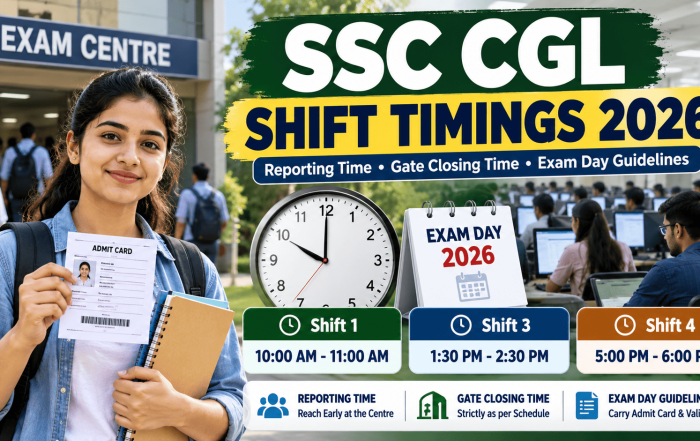
SSC CGL Shift Timings 2026: Reporting Time & Rules
Mission Gyan2026-10-01T12:50:00+05:30October 1, 2026|0 Comments
SSC CGL Shift Timings 2026: Reporting Time & Rules Candidates appearing for the SSC CGL Tier 1 Exam 2026 should carefully check their shift timing, reporting time and gate-closing time before visiting the examination centre. [...]
SSC CGL Exam Analysis 1 October 2026: Shift 1 Review
Mission Gyan2026-10-01T12:22:27+05:30October 1, 2026|1 Comment
SSC CGL Exam Analysis 1 October 2026: Shift 1 Review The SSC CGL Exam Analysis 1 October 2026 gives candidates a clear view of the Shift 1 paper. It covers the difficulty level, section-wise review, [...]
Supreme Court JCA Syllabus 2026, Exam Pattern & PDF
Mission Gyan2026-10-01T11:49:06+05:30October 1, 2026|0 Comments
Supreme Court JCA Syllabus 2026, Exam Pattern & PDF The Supreme Court JCA Syllabus 2026 and latest exam pattern are essential for candidates preparing for the Junior Court Assistant recruitment examination. The Supreme Court of [...]

Supreme Court JCA Recruitment 2026: 250 Posts
Mission Gyan2026-10-01T11:04:51+05:30October 1, 2026|0 Comments
Supreme Court JCA Recruitment 2026: 250 Posts The Supreme Court of India (SCI) has released the Supreme Court JCA Recruitment 2026 notification for 250 tentative Junior Court Assistant posts. The recruitment is being conducted for [...]
IBPS Clerk Vacancy 2026 Revised to 11,663 Posts
Mission Gyan2026-09-30T17:21:01+05:30September 30, 2026|0 Comments
IBPS Clerk Vacancy 2026 Revised to 11,663 Posts The IBPS Clerk Vacancy 2026 has increased to 11,663 posts after the addition of 260 new vacancies. This recruitment comes under the CRP CSA-XVI cycle for the [...]
SSC CGL Exam Analysis 2026: Good Attempts & Difficulty
Mission Gyan2026-09-30T15:20:19+05:30September 30, 2026|1 Comment
SSC CGL Exam Analysis 2026: Good Attempts & Difficulty The SSC CGL Exam Analysis 2026 helps candidates understand the Tier 1 exam level. It covers shift-wise difficulty, good attempts, exam pattern, negative marking and score [...]