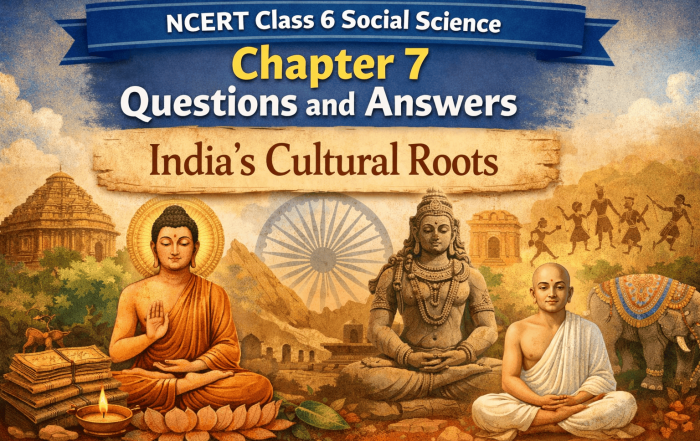
NCERT Class 6 Social Science Chapter 7 Questions and Answers
India’s Cultural Roots
This guide provides clear and student-friendly answers for India’s Cultural Roots NCERT Class 6 Social Science Chapter 7. Students can easily understand the important concepts of India’s Cultural Roots NCERT through these simplified explanations.
The chapter explains important ideas from Vedic traditions, Buddhism, Jainism, and tribal cultures, which together shaped India’s rich cultural heritage.
These answers are simplified, unique, and easy for students to understand and revise.
Table of Contents
Question 1 – Nachiketa and Yama
Question 2 – Central Ideas of Buddhism
Question 3 – Meaning of Buddha’s Quote
Question 4 – Central Ideas of Jainism
Question 5 – Andre Beteille’s Thought
Question 6 – Gods, Goddesses and Festivals
Question 7 – Tribal Groups and Their Art
True or False
FAQs
Question 1. If you were Nachiketa, what questions would you like to ask Yama? Write them down in 100–150 words.
Answer:
If I were Nachiketa and met Yama, the god of death, I would ask questions that help me understand life and the soul. I would ask what the true nature of the soul (Atman) is and how it is different from the body and the mind. I would also ask what happens to a person after death and whether the soul is reborn again.
Another question would be about the ultimate truth (Brahman) and how people can realise it while living. I would also want to know how karma influences our lives and future births. Finally, I would ask how a person can live a righteous life, remove the fear of death, and achieve liberation (moksha).
Question 2. Explain a few central ideas of Buddhism. Briefly comment upon them.
Answer:
Buddhism is based on teachings that help people understand suffering and find a path to peace. The most important teachings are the Four Noble Truths and the Eightfold Path.
The Four Noble Truths explain that life includes suffering, suffering is caused by desire, suffering can end, and there is a path that leads to the end of suffering.
The Eightfold Path guides people to live a balanced and disciplined life. It includes right understanding, right intention, right speech, right action, right livelihood, right effort, right mindfulness, and right concentration.
Buddhism also emphasises karma, which means that a person’s actions influence their future. These teachings encourage kindness, self-control, and awareness.
The teachings discussed in India’s Cultural Roots NCERT explain how Buddhism encouraged moral living and mindfulness.
Question 3. Discuss in class the quotation of the Buddha which begins with “Not by water is one made pure, though many people may bathe here [in sacred rivers” to make sure that its meaning has been understood by all.
Answer:
This quotation of the Buddha explains that true purity does not come from rituals or physical actions alone. Many people believe that bathing in sacred rivers can make them spiritually pure. However, the Buddha taught that real purity comes from good behaviour and a clear mind.
A person becomes pure through honesty, kindness, and self-discipline. Avoiding harmful actions and developing good thoughts are more important than performing rituals. The message highlights that inner transformation and moral living lead to true spiritual growth, not just external practices.
Question 4. Explain a few central ideas of Jainism. Briefly comment upon them.
Answer:
Jainism teaches a disciplined and peaceful way of life. Its philosophy is mainly based on three principles: ahimsa, anekantavada, and aparigraha.
Ahimsa (non-violence) means avoiding harm to all living beings. Jains believe that every form of life deserves respect and protection.
Anekantavada (many-sided truth) teaches that reality can be understood from different perspectives. This idea encourages tolerance and open-minded thinking.
Aparigraha (non-attachment) advises people to limit their desires and possessions. Living simply helps individuals focus on spiritual development.
Together, these teachings promote compassion, humility, and peaceful coexistence.
Question 5. Consider and discuss in class Andre Beteille’s thought (see page 122).
Answer:
Andre Beteille is a well-known Indian sociologist who studied the development of Indian society. According to his views, Indian religions and cultural traditions evolved through the interaction of different communities.
In ancient India, many castes and tribal groups had their own customs, beliefs, and rituals. Over time, these traditions influenced Hindu practices. Similarly, Hindu beliefs also affected tribal cultures.
This interaction created a rich and diverse religious tradition. Beteille’s thought helps us understand that Indian culture developed through continuous exchange and blending of ideas among communities.
Question 6. Make a list of popular gods and goddesses in your region and the festivals they are associated with.
Answer:
Here are some popular gods and goddesses along with the festivals associated with them:
Lord Rama and Hanuman – Diwali
Diwali celebrates the return of Lord Rama to Ayodhya after defeating Ravana.
Lord Ganesha – Ganesh Chaturthi
Celebrated as the birth anniversary of Lord Ganesha.
Lord Shiva – Maha Shivaratri
Devotees worship Lord Shiva and observe fasting and prayers.
Lord Krishna – Janmashtami
Marks the birth of Lord Krishna.
Goddess Durga – Durga Puja / Navratri
Celebrates the victory of Goddess Durga over Mahishasura.
Goddess Lakshmi – Diwali
Worshipped as the goddess of wealth and prosperity.
Students can also include festivals and deities that are popular in their local region.
Question 7. As a class activity, list two or three tribal groups from your region or State. Document some of their art and belief systems.
Answer:
Some well-known tribal groups in India include:
Gonds
Bhils
Santhals
Mundas
Great Andamanese
Many tribal communities believe that nature, animals, plants, and ancestors possess spiritual power. Their belief systems show deep respect for nature.
Tribal art reflects their traditions and daily life. For example, Bhil art is famous for its bright colours and simple patterns. It is often painted on walls, floors, and cloth.
These art forms preserve the identity, culture, and stories of tribal communities.
True or False
Question 1. The Vedic hymns were written on palm-leaf manuscripts.
Answer: True
Question 2. The Vedas are India’s oldest texts.
Answer: True
Question 3. The Vedic statement ekam sat vipra bahudha vadanti reflects a belief in the unity of cosmic powers.
Answer: True
Question 4. Buddhism is older than the Vedas.
Answer: False
Question 5. Jainism emerged as a branch of Buddhism.
Answer: False
Question 6. Both Buddhism and Jainism advocated for peaceful coexistence and the avoidance of harm to all living beings.
Answer: True
Question 7. Tribal belief systems are limited to belief in spirits and minor deities.
Answer: False
FAQs
What is the main teaching of Buddhism?
Buddhism teaches that suffering exists but can end through the Four Noble Truths and the Eightfold Path.
What are the three main principles of Jainism?
The three main principles are Ahimsa (non-violence), Anekantavada (many-sided truth), and Aparigraha (non-attachment).
What is the meaning of “Ekam Sat Vipra Bahudha Vadanti”?
It means truth is one, but wise people describe it in different ways, showing unity behind different beliefs.
Conclusion
The chapter India’s Cultural Roots NCERT helps students understand how ancient philosophies, religions, and tribal traditions shaped Indian society. Teachings from the Vedas, Buddhism, and Jainism emphasise values like non-violence, wisdom, discipline, and respect for life.
Understanding these ideas allows students to appreciate the diversity and depth of India’s cultural heritage.
👉 If this guide helped you, share it with classmates and explore more NCERT Class 6 Social Science solutions on our website.