UIIC AO Exam Analysis 2026: Good Attempts, Difficulty Level & Questions Asked
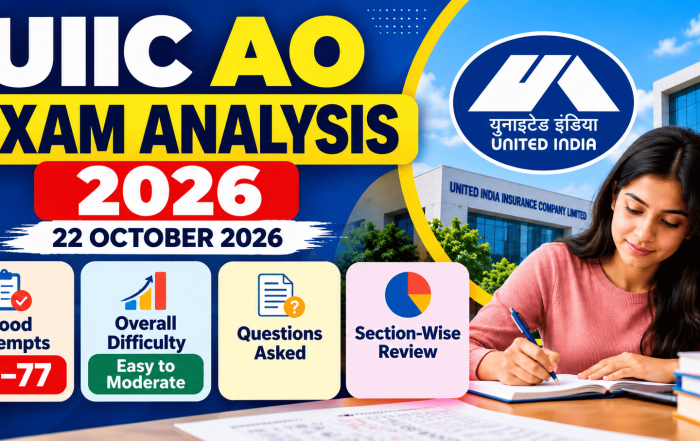
The UIIC AO Exam Analysis 2026 is out for the exam held on 22 October 2026. According to CareerPower, the overall paper was Easy to Moderate. Moreover, its review suggests 71–77 good attempts.
The United India Insurance Company Limited (UIIC) held the Administrative Officer (AO) Prelims exam online. The paper had 100 questions across three sections. Candidates had 60 minutes to finish the test.
In this article, you can explore the UIIC AO Prelims Exam Analysis 2026. We cover good attempts, section-wise difficulty and questions asked. In addition, we explain the exam pattern and how to calculate your expected score.
Latest Update – 22 October 2026: CareerPower has shared its post-exam review. However, the reported good attempts and difficulty ratings reflect candidate feedback. UIIC has not announced these figures as official cut-off marks.
UIIC AO Exam Analysis 2026 Overview
The UIIC AO Prelims exam tested three subjects: English Language, Reasoning Ability and Quantitative Aptitude.
Each section had a separate 20-minute time limit. Therefore, candidates needed both speed and accuracy.
The table below shows the main exam details.
| Particulars | Details |
|---|
| Organization | United India Insurance Company Limited |
| Exam Name | UIIC AO Prelims 2026 |
| Post | Administrative Officer |
| Exam Date | 22 October 2026 |
| Exam Mode | Online |
| Total Questions | 100 |
| Maximum Marks | 100 |
| Exam Duration | 60 Minutes |
| Total Sections | 3 |
| Sectional Time | 20 Minutes Each |
| Negative Marking | 0.25 Marks |
| Overall Difficulty | Easy to Moderate |
| Estimated Good Attempts | 71–77 |
| Official Website | https://uiic.co.in/ |
Overall, the published review suggests that candidates could handle many questions. However, accuracy also plays a major role in the final score.
UIIC AO Prelims Difficulty Level 2026
The UIIC AO Prelims Difficulty Level 2026 helps candidates understand the paper’s difficulty.
CareerPower rated the overall exam Easy to Moderate. In particular, Reasoning Ability received an Easy rating.
Meanwhile, English Language and Quantitative Aptitude received Easy to Moderate ratings. Nevertheless, candidates may have different experiences.
For example, some candidates may solve reasoning puzzles faster than numerical problems. Therefore, the difficulty level can feel different for each person.
Section-Wise Difficulty Level
| Section | Difficulty Level |
|---|
| English Language | Easy to Moderate |
| Reasoning Ability | Easy |
| Quantitative Aptitude | Easy to Moderate |
| Overall | Easy to Moderate |
Key Takeaway: The published review rates Reasoning Ability as the easiest section. However, candidates should consider their own correct answers before judging their performance.
UIIC AO Prelims Good Attempts 2026
The UIIC AO Good Attempts 2026 help candidates compare their exam performance.
According to CareerPower, the overall range stands at 71–77 good attempts. However, this estimate does not guarantee selection.
Instead, good attempts show how many questions candidates might solve with strong accuracy.
Section-Wise Good Attempts
| Subject | Questions | Good Attempts |
|---|
| English Language | 30 | 20–22 |
| Reasoning Ability | 35 | 28–30 |
| Quantitative Aptitude | 35 | 23–25 |
| Overall | 100 | 71–77 |
For example, a candidate with 65 correct answers may score higher than someone who attempts 80 questions with many errors.
As a result, candidates should consider accuracy along with their total attempts.
UIIC AO Prelims Section-Wise Exam Analysis 2026
The paper included three sections. Each section tested different skills.
Moreover, the short time limits made question selection important. Let’s look at the reported topics and question counts.
UIIC AO Reasoning Ability Analysis 2026
Reasoning Ability included 35 questions worth 35 marks. Candidates had 20 minutes to complete this section.
CareerPower rated Reasoning Ability Easy. In particular, puzzles and seating arrangements formed a large part of the paper.
Reasoning Ability Questions Asked
| Topic | Questions |
|---|
| Puzzles and Seating Arrangements | 18 |
| Chinese Coding | 5 |
| Syllogism | 3 |
| Inequality | 3 |
| Blood Relations | 3 |
| Word Pairing | 1 |
| Number Pairing | 1 |
| Number-Based Questions | 1 |
| Total | 35 |
Important Puzzles Asked
The review identified four major puzzle sets:
- Month-Based Puzzle: 5 questions involving eight months and eight people.
- Uncertain Linear Arrangement: 3 questions.
- Parallel Row Arrangement: 5 questions involving 12 people.
- Circular Seating Arrangement: 5 questions involving six people.
Together, these sets covered 18 questions. In addition, candidates faced questions on Coding, Syllogism and Blood Relations.
Reasoning Ability Highlights
- Total Questions: 35
- Difficulty Level: Easy
- Estimated Good Attempts: 28–30
- Time Limit: 20 Minutes
Overall, candidates with strong reasoning skills had good scoring opportunities. However, careful question selection remained important.
UIIC AO Quantitative Aptitude Analysis 2026
Quantitative Aptitude included 35 questions worth 35 marks. Candidates had 20 minutes to complete the section.
CareerPower rated this section Easy to Moderate. However, some questions required longer calculations.
The paper included Data Interpretation, Approximation and Number Series. Therefore, calculation speed played an important role.
Quantitative Aptitude Questions Asked
| Topic | Questions |
|---|
| Caselet Data Interpretation | 5 |
| Approximation | 4 |
| Wrong Number Series | 4 |
| Quantity Comparison | 3 |
| Line Graph Data Interpretation | 5 |
| Reported Topic Subtotal | 21 |
| Other Questions | Full breakdown unavailable |
| Total Questions | 35 |
The published review lists topic counts for 21 questions. However, it does not explain the other 14 questions in detail.
Therefore, the table keeps the remaining questions separate rather than adding unconfirmed figures.
Quantitative Aptitude Key Points
Data Interpretation formed an important part of the reported paper. In addition, Wrong Number Series required careful attention.
For example, lengthy calculations can take extra time. As a result, candidates may have less time for easier questions.
Quantitative Aptitude Highlights
- Total Questions: 35
- Difficulty Level: Easy to Moderate
- Estimated Good Attempts: 23–25
- Time Limit: 20 Minutes
Overall, candidates needed strong calculation skills. Nevertheless, accuracy remained important because the exam had negative marking.
UIIC AO English Language Analysis 2026
English Language included 30 questions worth 30 marks. Candidates had 20 minutes to complete this section.
CareerPower rated the difficulty level Easy to Moderate.
The questions tested reading, grammar and vocabulary. Moreover, candidates needed to understand sentence structure and word usage.
English Language Questions Asked
| Topic | Questions |
|---|
| Reading Comprehension | 8 |
| Error Detection | 5 |
| Cloze Test | 5 |
| Sentence Rearrangement | 3–4 |
| Phrase Replacement | 3–4 |
The published review reports these figures. However, it does not confirm the full topic-wise count for all 30 questions.
Reading Comprehension Topic
The passage focused on a story about escaping from North Korea to China.
It included eight questions. Meanwhile, other questions tested grammar and sentence order.
English Language Highlights
- Total Questions: 30
- Difficulty Level: Easy to Moderate
- Estimated Good Attempts: 20–22
- Time Limit: 20 Minutes
Overall, candidates needed good reading and grammar skills. Therefore, careful reading could help them avoid errors.
UIIC AO Prelims Exam Pattern 2026
The UIIC AO Prelims Exam Pattern 2026 included 100 questions worth 100 marks.
The exam had three sections, and each section had a separate 20-minute time limit.
Moreover, every correct answer carried one mark. However, each wrong answer attracted a penalty of 0.25 marks.
UIIC AO Exam Pattern
| Subject | Questions | Marks | Duration |
|---|
| English Language | 30 | 30 | 20 Minutes |
| Reasoning Ability | 35 | 35 | 20 Minutes |
| Quantitative Aptitude | 35 | 35 | 20 Minutes |
| Total | 100 | 100 | 60 Minutes |
Important Exam Rules
- UIIC held the examination online.
- The paper included 100 objective questions.
- Each correct answer carried one mark.
- Every wrong answer attracted a 0.25-mark penalty.
- Unanswered questions carried no penalty.
- Each section had a separate time limit.
Therefore, candidates needed to balance speed and accuracy.
How to Calculate UIIC AO Prelims Expected Score 2026
Candidates can estimate their scores using the marking scheme.
First, count your correct answers. Next, count your wrong answers. Then, calculate the penalty for incorrect answers.
Finally, subtract the penalty from your marks.
Expected Score = Correct Answers − (Wrong Answers × 0.25)
Expected Score Example
Suppose a candidate attempted 70 questions. Of these, 62 answers were correct, while eight were wrong.
| Particulars | Value |
|---|
| Total Attempts | 70 |
| Correct Answers | 62 |
| Wrong Answers | 8 |
| Marks from Correct Answers | 62 |
| Negative Marks | 2 |
| Expected Score | 60 |
Therefore, the candidate’s estimated score would be 60 out of 100.
However, this calculation only provides an estimate. Candidates should check their official results for final marks.
UIIC AO Expected Cut Off 2026
Many candidates also want to know the UIIC AO Expected Cut Off 2026.
The cut-off depends on several factors. For example, available vacancies and candidate performance can affect qualifying marks.
In addition, the overall exam difficulty may influence the final cut-off.
Factors That May Affect the Cut-Off
- Total vacancies
- Number of candidates
- Exam difficulty
- Candidate performance
- Category-wise recruitment rules
However, good attempts and cut-off marks are different.
For example, the 71–77 good-attempt range does not mean UIIC will set the cut-off within the same range.
Therefore, candidates should rely on official UIIC announcements for qualifying marks.
What Should Candidates Do After UIIC AO Prelims 2026?
After the exam, candidates should review their performance and plan their next steps.
First, calculate your expected score. Next, compare your attempts with the published exam review.
Meanwhile, check the official UIIC website for recruitment updates.
Important Next Steps
- Count your correct answers.
- Count your wrong answers.
- Calculate negative marks.
- Review your section-wise performance.
- Prepare for the next selection stage.
- Follow official recruitment notices.
As a result, candidates can plan their preparation more effectively.
UIIC AO Exam Analysis 2026 FAQs
Q1. What was the difficulty level of UIIC AO Prelims 2026?
CareerPower rated the overall exam Easy to Moderate. However, individual candidates may have different views.
Q2. What were the good attempts in UIIC AO Prelims 2026?
The published estimate ranged from 71 to 77 questions. However, this range does not represent official cut-off marks.
Q3. Which section was easiest in UIIC AO Prelims 2026?
CareerPower rated Reasoning Ability Easy. Therefore, candidates with strong reasoning skills may have found it manageable.
Q4. How many questions were in UIIC AO Prelims 2026?
The paper had 100 questions. English Language had 30 questions, while Reasoning Ability and Quantitative Aptitude had 35 each.
Q5. Was UIIC AO Quantitative Aptitude difficult?
CareerPower rated it Easy to Moderate. However, some questions required lengthy calculations.
Q6. What was the Reading Comprehension topic?
The passage focused on a story about escaping from North Korea to China. It included eight questions.
Conclusion
The UIIC AO Exam Analysis 2026 helps candidates review the preliminary exam held on 22 October 2026.
According to CareerPower, the overall paper was Easy to Moderate. Moreover, the estimated good attempts ranged from 71 to 77 questions.
Reasoning Ability was the easiest section in the published review. Meanwhile, English Language and Quantitative Aptitude received Easy to Moderate ratings.
Therefore, candidates should focus on accuracy as well as total attempts. In addition, they should follow official UIIC updates for results and cut-off marks.