Class 6 Social Science Chapter 8: Unity in Diversity Answers
If you are looking for Class 6 Unity in Diversity answers, this guide will help you understand the chapter in a simple and student-friendly way. The questions have been kept the same, but the answers have been rewritten in clear and polished language for better classroom discussion. These Unity in Diversity answers are useful for students, teachers, and educational blogs focused on Indian culture, heritage, moral stories, and social harmony.
1. Conduct a class discussion on the two quotations at the start of the chapter.
Answer
Quotation 1
“Oh, grant me my prayer, that I may never lose the bliss of the touch of the one in the play of the many.” — Rabindranath Tagore
This quotation tells us that although the world is full of many people, cultures, and experiences, there is still a deep unity connecting all of them. Tagore reminds us that true joy comes from feeling this oneness in the middle of diversity.
Discussion Points
Diversity is a natural part of human life.
People may be different in language, dress, or customs, but they share common human feelings.
Respecting diversity helps build peace and harmony.
Unity in diversity becomes stronger when we learn to appreciate differences.
Quotation 2
“The principle of unity in diversity which has always been normal to India and its fulfillment the fundamental course of her being and its very nature, the Many in the One, would place her on the sure foundation of her Swabhava and Swadharma.” — Sri Aurobindo
Sri Aurobindo explains that India’s real strength lies in its ability to remain united despite having many religions, languages, customs, and traditions. He believed that this quality is part of India’s true nature.
Discussion Points
India is a land of great diversity.
In spite of differences, people are connected through shared cultural values.
Unity in diversity is one of the strongest features of Indian society.
This idea remains highly relevant in present-day India.
These Unity in Diversity answers help students understand how diversity and cultural harmony shape Indian society.
2. Select a few stories from the Panchatantra and discuss how their message is still valid today. Do you know of any similar stories from your region?
Answer
The Panchatantra is full of wise and meaningful stories that continue to teach important lessons even today. These stories are simple, but their messages are timeless.
Story 1: The Monkey and the Crocodile
This story teaches us about trust, intelligence, and betrayal. The monkey survives danger because he remains calm and uses his intelligence when the crocodile tries to cheat him.
Message:
We should be careful about whom we trust, and we should use wisdom in difficult situations.
Story 2: The Tortoise and the Geese
This story teaches the value of self-control and silence. The tortoise gets into trouble because he cannot control his speech.
Message:
Speaking without thinking can lead to problems. Patience and self-control are very important qualities.
Similar Story from the Region
A similar story told in many regions is that of a clever rabbit who outsmarts a lion. Like the Panchatantra, this story shows that intelligence is often more powerful than physical strength.
Why These Stories Are Still Relevant
They teach practical life lessons.
They show the importance of wisdom, discipline, and careful decision-making.
Their moral values still apply in modern life.
3. Collect a few folk tales from your region and discuss their message.
Answer
Folk tales are an important part of regional culture. They preserve local traditions and pass moral lessons from one generation to the next.
Folk Tale 1: The Legend of King Bhoja and the Vetala
This tale highlights the value of wisdom, patience, and cleverness. It shows that difficult situations can often be solved through intelligence.
Message:
Quick thinking and wisdom are essential for solving problems.
Folk Tale 2: The Story of the Charitable Banyan Tree
This story focuses on kindness, generosity, and selflessness. The banyan tree gives shelter and support to all without expecting anything in return.
Message:
Helping others and being generous are noble values.
Discussion Points
Folk tales teach lasting moral lessons.
They reflect the beliefs and traditions of a community.
They often promote virtues like courage, kindness, wisdom, and honesty.
Their messages remain meaningful even today.
4. Is there any ancient story that you have seen being depicted through a form of art? It could be a sculpture, a painting, a dance performance, a movie with your classmates.
Answer
Yes, many ancient Indian stories have been beautifully depicted through different forms of art. One famous example is the Mahabharata, which is presented through dance performances such as Kathakali and Bharatanatyam, as well as paintings, sculptures, theatre, and films.
These art forms use expressions, music, gestures, costumes, and movement to make the stories come alive. They help people understand ancient stories in a more interesting and memorable way.
Discussion Points
Art helps preserve ancient stories for future generations.
Dance, painting, sculpture, and cinema make stories easier to connect with.
Artistic forms play an important role in cultural education.
They keep India’s rich heritage alive in modern times.
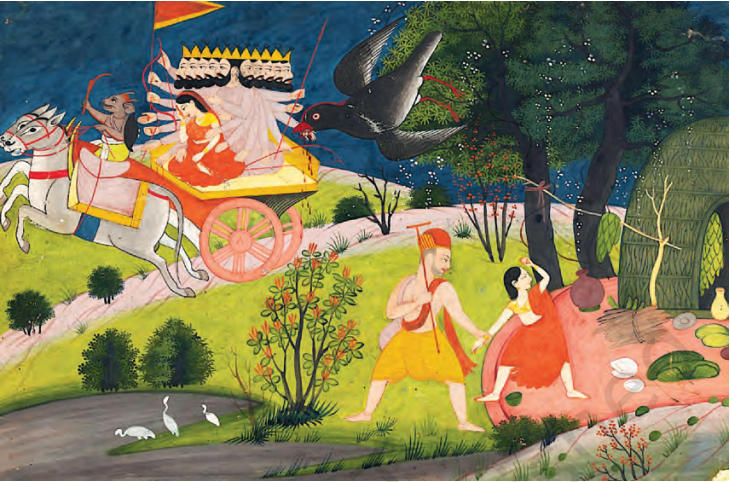
5. Discuss in class the following quotation by India’s first prime minister, Jawaharlal Nehru, when he travelled to many parts of India before Independence.
“Everywhere I found a cultural background which had exerted a powerful influence on their lives…. The old epics of India, the Ramayana and the Mahabharata and other books, in popular translations and paraphrases, were widely known among the masses, and every incident and story and moral in them was engraved on the popular mind and gave a richness and content to it. Illiterate villagers would know hundreds of verses by heart and their conversation would be full of references to them or to some story with a moral, enshrined in some old classic.”
Answer
Jawaharlal Nehru observed that Indian epics like the Ramayana and the Mahabharata had a deep influence on the lives of people across the country. Even those who could not read were familiar with these stories through oral traditions, public recitations, storytelling, and performances.
His words show that these epics were not just literary works. They were a living part of everyday life, shaping people’s values, thoughts, and cultural identity.
Discussion Points
The epics deeply influenced Indian society and moral values.
Oral traditions helped preserve culture among common people.
Shared stories created a sense of unity across different regions.
Ancient epics still continue to influence Indian life and thought.
Why These Unity in Diversity Answers Matter
These Unity in Diversity answers are helpful because they:
explain ideas in simple language
connect old stories with modern life
improve classroom discussion and understanding
highlight the importance of Indian culture and heritage
Frequently Asked Questions
Why is unity in diversity important in India?
Unity in diversity is important because India has many languages, religions, traditions, and customs, yet people remain connected through shared values and cultural heritage.
Why are Panchatantra stories still relevant today?
Panchatantra stories remain relevant because they teach practical lessons about wisdom, honesty, caution, friendship, and self-control.
What do folk tales teach us?
Folk tales teach moral values such as kindness, bravery, wisdom, generosity, and honesty while preserving regional culture.
How do art forms help preserve ancient stories?
Art forms such as dance, theatre, painting, and sculpture make ancient stories interesting and memorable, helping new generations understand and appreciate them.
What did Jawaharlal Nehru say about Indian epics?
Nehru said that epics like the Ramayana and Mahabharata had a strong influence on people’s lives and were deeply rooted in the minds of the masses.
Conclusion
These Unity in Diversity answers explain how Indian culture is shaped by diversity, moral stories, folk traditions, art, and epic literature. From the wisdom of the Panchatantra to the cultural influence of the Ramayana and Mahabharata, these ideas continue to guide society even today.
If you found this guide useful, share it with your classmates, teachers, or friends, and explore more educational content on Indian culture, heritage, and literature.