For the academic year 2024–2025, the CBSE English syllabus for Class 7 consists of a thorough study plan with three main sections: grammar, supplementary reading “An Alien Hand,” and the textbook “Honeycomb.” The textbook Honeycomb includes both prose and poems. The main goals of the English curriculum for Class 7 are to strengthen grammatical precision, foster literary appreciation, and build a strong linguistic foundation. Students are not just ready for more difficult coursework, but also for real-world language use in daily life and the workplace of the future.
The Class 7 English syllabus promotes a well-rounded development of language abilities by fusing literature with thorough grammar instruction, assisting students in becoming proficient and self-assured in their use of the language.
CBSE Class 7 English Chapters – HoneyComb
Unit
Chapter Name
Unit – 1
Three Questions The Squirrel
Unit – 2
A Gift of Chappals The Rebel
Unit – 3
Gopal and Hilsa Fish The Shed
Unit – 4
The Ashes that made trees bloom Chivvy
Unit – 5
Quality Trees
Unit – 6
Expert Detectives Mystery of The Talking Fan
Unit – 7
The Invention of Vita-Wonk Dad and the Cat and the Tree Garden Snake
Unit – 8
The Invention of Vita-Wonk Dad and the Cat and the Tree Garden Snake
CBSE Class 7 English Chapters – An Alien Hand (Supplementary Reader)
Unit
Chapter Name
Unit – 1
The Tiny Teacher
Unit – 2
Bringing up Kari
Unit – 3
Golu Grows a Nose
Unit – 4
Chandni
Unit – 5
The Bear Story
Unit – 6
A Tiger in the House
Unit – 7
An Alien Hand
Conclusion:
The Class 7 CBSE English syllabus for the 2024–25 school year is carefully crafted to improve students’ comprehension and fluency in the language by emphasizing literature, additional reading, and grammar in a balanced manner.
The literary component seeks to assist students enhance their critical thinking and interpretive abilities by fostering an appreciation for various writing genres and styles. While “An Alien Hand” provides captivating stories that foster knowledge and imagination, “Honeycomb”‘s prose and poetry expose pupils to a variety of subjects and characters.
The extensive grammar part covers all the necessary topics, including tenses, Sentence structure, modals, and parts of speech. This guarantees that students acquire a strong foundation in English grammar, which is essential for proficient writing and communication.
The overall goal of the Class 7 English syllabus is to strengthen analytical skills, promote creative expression, and provide a solid linguistic foundation. It equips students for both more difficult academic work and real-world language use in everyday situations and potential work settings.
Frequently Asked Questions (FAQ’S):
Q1. What is the structure of the Class 7 English syllabus under CBSE?
A1. The Class 7 English syllabus under CBSE is divided into two main parts:
Literature: This includes prose, poetry, and supplementary reading.
Language: This covers grammar, writing, and comprehension skills.
Q2. What are the prescribed textbooks for Class 7 English?
A2. The CBSE prescribes the following textbooks for Class 7 English:
Honeycomb (Prose and Poetry)
An Alien Hand (Supplementary Reader)
Q3. What are some key themes covered in the Honeycomb textbook?
A3. The Honeycomb textbook includes various themes such as:
Moral values and ethics
Nature and environment
Adventure and exploration
Historical events and biographies
Social issues and family relationships
Q4. What types of questions are included in the literature section?
A4. The literature section typically includes :
Short Answer Questions (SAQs): These test understanding and recall of the text.
Long Answer Questions (LAQs): These assess analytical and interpretive skills.
Extract-based Questions: These involve reading a passage and answering related questions.
Vocabulary Questions: These test the understanding of word meanings and usage in context.
Q5. What grammar topics are covered in Class 7 English?
A5. The grammar section usually includes:
Parts of Speech (Nouns, Pronouns, Adjectives, Verbs, Adverbs, Prepositions, Conjunctions, Interjections)
Tenses (Past, Present, Future)
Subject-Verb Agreement
Modals and Auxiliaries
Direct and Indirect Speech
Active and Passive Voice
Clauses (Noun, Adjective, Adverb)
Q6. What types of writing tasks are students expected to complete?
A6. Students are expected to complete various writing tasks such as:
Essay writing, Letter writing (formal and informal), Diary entries, Notice writing, Paragraph writing, Story writing, and Report writing.
Q7. How is reading comprehension evaluated?
A7. Reading comprehension is evaluated through passages followed by questions that test:
Understanding of the main idea and supporting details
Inference and Interpretation
Vocabulary and word meaning in context
Summarizing and paraphrasing
Q8. How are students assessed in English?
A8. Students are assessed through:
Periodic Tests: These are short assessments conducted throughout the year.
Mid-term and Final Exams: These are more comprehensive assessments.
Assignments and Projects: These may include book reports, presentations, and creative writing tasks.
Oral Assessments: These may involve reading aloud, recitation, and oral presentations.
Q9. What resources can help students prepare for exams?
A9. Students can use various resources to prepare, such as:
NCERT textbooks and solutions
CBSE sample papers and previous years’ question papers
Reference books for additional practice
Online resources and educational websites
Study guides and revision notes.
Download CBSE Class 7th English Syllabus 2024-25 PDF
GDS Result 2026: Check India Post Merit List PDF The GDS Result 2026 is an important update for candidates who applied for India Post Gramin Dak Sevak recruitment. India Post will publish the result online [...]
RRB NTPC Graduate Recruitment 2026: 3,477 Posts The Railway Recruitment Boards (RRBs) have announced 3,477 vacancies under RRB NTPC Graduate Recruitment 2026. RRBs will hold this recruitment under CEN 06/2026. In addition, the drive covers [...]
Union Bank SO Recruitment 2026: 395 Vacancies Union Bank SO Recruitment 2026 was announced for 395 Specialist Officer and General Banking Officer vacancies under the Union Bank Recruitment Project 2026–27. The recruitment includes posts for [...]
JTET Exam Date 2026: JAC Schedule, Admit Card Soon The JTET Exam Date 2026 is expected soon. The Jharkhand Academic Council (JAC) will announce the official exam schedule on its examination portal. Candidates preparing for [...]
Canara Bank Apprentice Recruitment 2026: 3500 Seats Canara Bank Apprentice Recruitment 2026 brings an opportunity for graduates who want apprenticeship training in the banking sector. According to the available recruitment details, Canara Bank has 3,500 [...]
Assam Rifles Recruitment 2026: Apply Online for 354 Posts The Assam Rifles Recruitment 2026 application process has started for 354 Group C Technical and Tradesman vacancies. Eligible candidates can submit the online application form from [...]
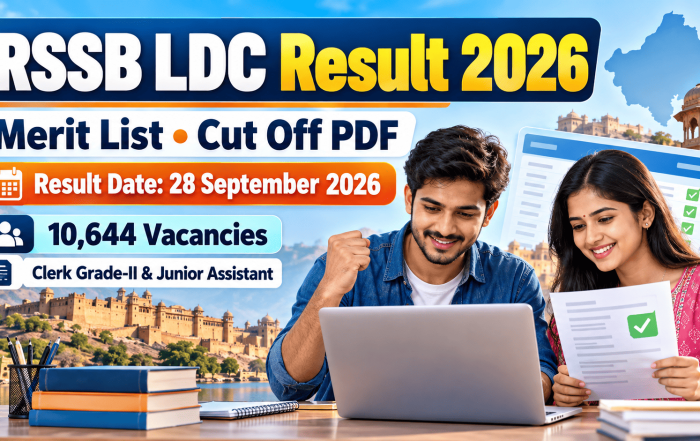
RSSB LDC Result 2026: Merit List, Cut Off PDF The RSSB LDC Result 2026 is scheduled for 28 September 2026. Candidates who appeared in the Clerk Grade-II and Junior Assistant exam can check the result [...]
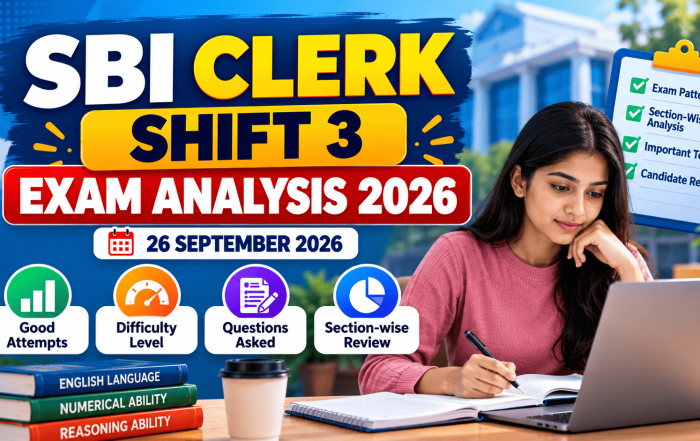
SBI Clerk Shift 3 Exam Analysis 2026: Live Review The SBI Clerk Shift 3 Exam Analysis 2026 for 26 September 2026 will help candidates understand the latest exam trends. Here, candidates can check the difficulty [...]
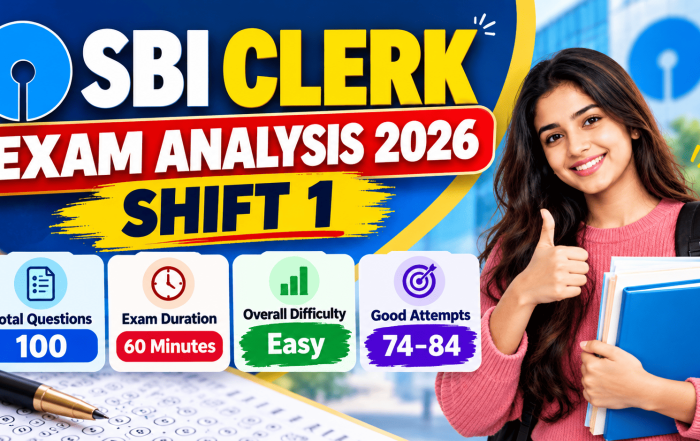
SBI Clerk Exam Analysis 2026 Shift 1, Good Attempts The SBI Clerk Exam Analysis 2026 Shift 1 for 26 September gives candidates a clear review of the Prelims paper. Here, you can check the good [...]
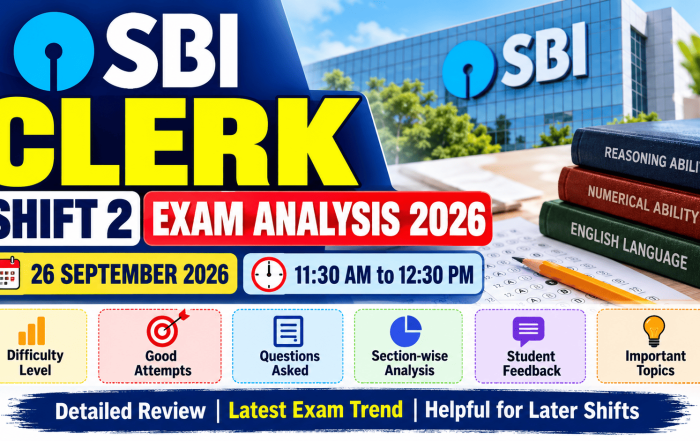
SBI Clerk Shift 2 Exam Analysis 2026, 26 Sept The SBI Clerk Shift 2 Exam Analysis 2026 for 26 September will help candidates understand the second shift of today's Prelims exam. Here, candidates can check [...]