2022-2023 CBSE Class 12 Economics Syllabus:CBSE Class 12 students in the commerce stream can view and download the revised CBSE Economics Syllabus here. The CBSE Class 12 Economics Syllabus for the current academic session, 2022-23, has been updated. This syllabus corresponds to the annual assessment. Students must read the entire syllabus in order to understand the most recent course structure and exam format. This curriculum also contains information on project work and question paper creation.
Download CBSE 12th Economics syllabus
Part A: Introductory Macro economics Unit
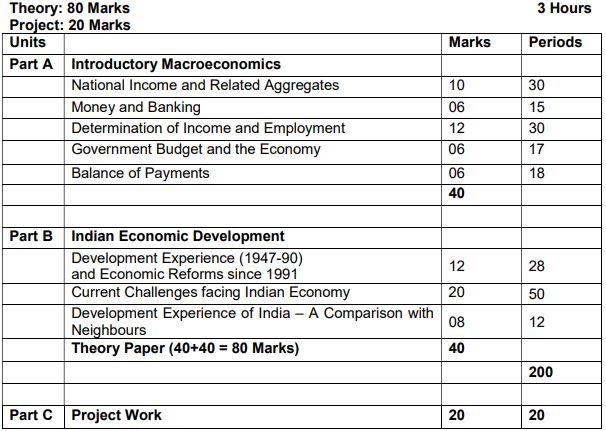
1: National Income and Related Aggregates (30 Periods)
Basic concepts in macroeconomics: consumption goods, capital goods, final goods, intermediate goods; stocks and flows; gross investment and depreciation. Circular flow of income (two sector model); Methods of calculating National Income – Value Added or Product method, Expenditure method, Income method. Aggregates related to National Income: Gross National Product (GNP), Net National Product (NNP), Gross Domestic Product (GDP) and Net Domestic Product (NDP) – at market price, at factor cost; Real and Nominal GDP.GDP and Welfare.
Unit 2: Money and Banking (15 Periods)
Money – meaning and functions, supply of money – Currency held by the public and net demand deposits held by commercial banks. Money creation by the commercial banking system. Central bank and its functions (example of the Reserve Bank of India): Bank of issue, Govt. Bank, Banker’s Bank, Control of Credit through Bank Rate, CRR, SLR, Repo Rate and Reverse Repo Rate, Open Market Operations, Margin requirement.
Unit 3: Determination of Income and Employment (30 Periods)
Aggregate demand and its components. Propensity to consume and propensity to save (average and marginal).Short-run equilibrium output; investment multiplier and its mechanism. Meaning of full employment and involuntary unemployment. Problems of excess demand and deficient demand; measures to correct them – changes in government spending, taxes and money supply.
Unit 4: Government Budget and the Economy (17 Periods)
Government budget – meaning, objectives and components.Classification of receipts – revenue receipts and capital receipts;Classification of expenditure – revenue expenditure and capital expenditure.Balanced, Surplus and Deficit Budget – measures of government deficit.
Unit 5: Balance of Payments (18 Periods)
Balance of payments account – meaning and components; Balance of payments – Surplus and Deficit Foreign exchange rate – meaning of fixed and flexible rates and managed floating. Determination of exchange rate in a free market, Merits and demerits of flexible and fixed exchange rate. Managed Floating exchange rate system
Part B: Indian Economic Development
Unit 6: Development Experience (1947-90) and Economic Reforms since 1991: (28 Periods)
A brief introduction of the state of Indian economy on the eve of independence. Indian economic system and common goals of Five Year Plans. Main features, problems and policies of agriculture (institutional aspects and new agricultural strategy), industry (IPR 1956; SSI – role & importance) and foreign trade. Economic Reforms since 1991: Features and appraisals of liberalisation, globalisation and privatisation (LPG policy); Concepts of demonetization and GST
Unit 7: Current challenges facing Indian Economy (60 Periods)
Human Capital Formation: How people become resource; Role of human capital in economic development; Growth of Education Sector in India Rural development: Key issues – credit and marketing – role of cooperatives; agricultural diversification; alternative farming – organic farming Employment: Growth and changes in work force participation rate in formal and informal sectors; problems and policies Sustainable Economic Development: Meaning, Effects of Economic Development on Resources and Environment, including global warming
Unit 8: Development Experience of India: (12 Periods)
A comparison with neighbours India and Pakistan India and China Issues: economic growth, population, sectoral development and other Human Development Indicators Part C: Project in Economics (20 Periods)
Prescribed Books: 1.Statistics for Economics, NCERT 2. Indian Economic Development, NCERT 3. Introductory Microeconomics, NCERT 4. Macroeconomics, NCERT 5. Supplementary Reading Material in Economics, CBSE
Conclusion
The 12th CBSE Economics syllabus is designed to provide students with a comprehensive understanding of various economic concepts, theories, and their real-world applications. The syllabus covers a wide range of topics, starting with microeconomics and macroeconomics, and further exploring topics such as inflation, unemployment, international trade, and economic reforms. Through this course, students will gain an understanding of how the economy functions, the factors that influence economic growth, and how policies are implemented to address economic issues.
FAQs
1: What is the CBSE Class 12 Economics syllabus?
The CBSE Class 12 Economics syllabus covers topics like Introduction to Microeconomics, Theory of Consumer Behaviour, Production and Costs, Market Equilibrium, National Income Accounting, Money and Banking, Balance of Payments, and more. You can find the detailed syllabus on the CBSE official website.
2:What is the best way to prepare for CBSE Class 12 Economics?
The best way to prepare for CBSE Class 12 Economics is to have a good understanding of the concepts and to practice solving numerical problems. You should also revise the important formulas and concepts regularly and solve previous year question papers.
3:How many marks are allotted for CBSE Class 12 Economics board exam?
The CBSE Class 12 Economics board exam is conducted for 80 marks. The remaining 20 marks are allotted for internal assessment.
4.What is the format of CBSE Class 12 Economics board exam?
The CBSE Class 12 Economics board exam consists of two parts: Part A and Part B. Part A consists of Microeconomics and carries 40 marks, while Part B consists of Macroeconomics and carries 40 marks. Both parts have compulsory questions and options to choose from.
To Check and download the full syllabus, click on the following link:
RRB JE City Intimation Slip 2026 Out: Download Link The RRB JE City Intimation Slip 2026 is out for the Junior Engineer CBT 1 exam. The Railway Recruitment Boards (RRBs) opened the exam city link [...]
ISRO Admit Card 2026 Out: Download Link & Exam Date ISRO Admit Card 2026 is out for the Scientist/Engineer ‘SC’ exam. According to recent reports, the Indian Space Research Organisation (ISRO) released the hall ticket [...]
RRB Isolated Categories Recruitment 2026: 195 Vacancies, Apply Online, Eligibility and Salary The RRB Isolated Categories Recruitment 2026 brings a new opportunity for railway job seekers. The Railway Recruitment Boards (RRBs) have announced plans to [...]
UIIC AO Exam Analysis 2026: Good Attempts, Difficulty Level & Questions Asked The UIIC AO Exam Analysis 2026 is out for the exam held on 22 October 2026. According to CareerPower, the overall paper was [...]
RRB Paramedical Exam Date 2026 Out, Check CBT Schedule RRB Paramedical Exam Date 2026 Out: The Railway Recruitment Boards (RRBs) have released the tentative Computer-Based Test (CBT) schedule for Paramedical Recruitment under CEN 05/2026. According [...]
UPPCL Recruitment 2026: 50,000+ Vacancies Expected UPPCL Recruitment 2026 may create new job opportunities in Uttar Pradesh. Recent news reports suggest that the state's power sector has over 50,000 vacant posts. As a result, many [...]
CWC Apply Online 2026: 327 Vacancies, Apply Now CWC Apply Online 2026 registration is open for 327 Assistant Manager and Junior Executive vacancies. The Central Warehousing Corporation (CWC) released its recruitment notification on 17 October [...]
RRB JE City Intimation Slip 2026 Out, CBT 1 City Link RRB JE City Intimation Slip 2026 Out: The Railway Recruitment Board (RRB) released the RRB JE CBT 1 City Intimation Slip 2026 on 17 [...]
Rajasthan SET Result 2026: Date, Cut Off & Scorecard Rajasthan SET Result 2026 is still awaited. The University of Kota may announce the result by the end of October 2026. However, the university has not [...]
UPSSSC Inter Level Vacancy 2026: 1784 Posts, Apply Online UPSSSC Inter Level Vacancy 2026: The Uttar Pradesh Subordinate Services Selection Commission (UPSSSC) has released the recruitment notification for 1,784 Intermediate-level government posts. The notification was [...]